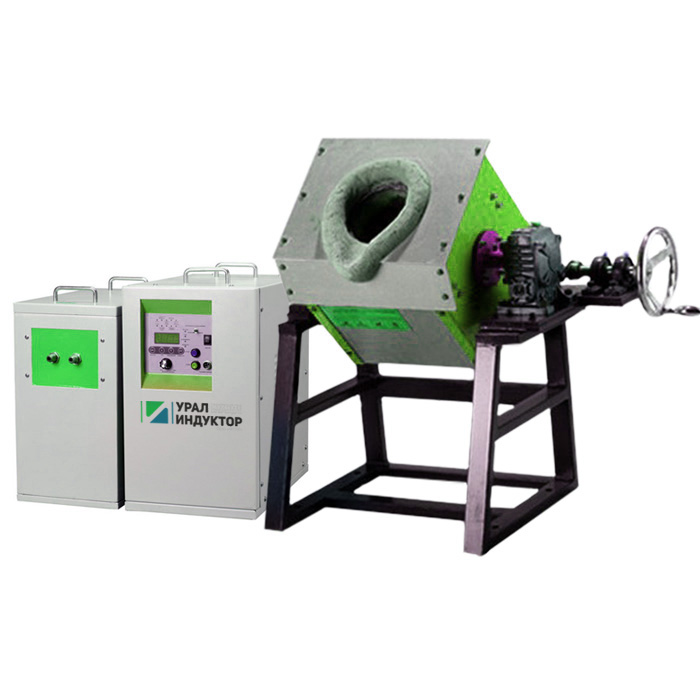
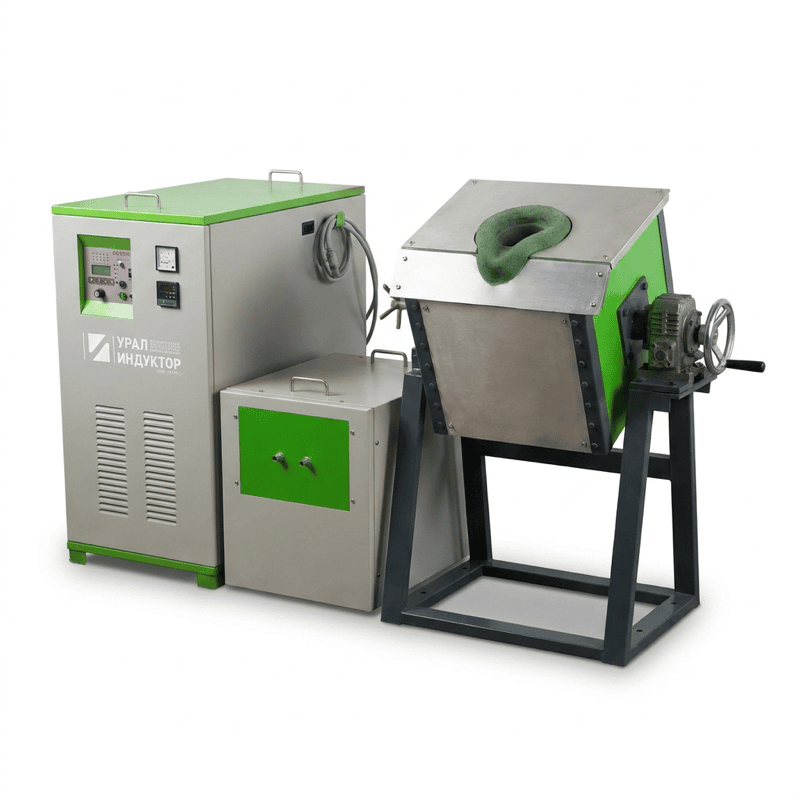
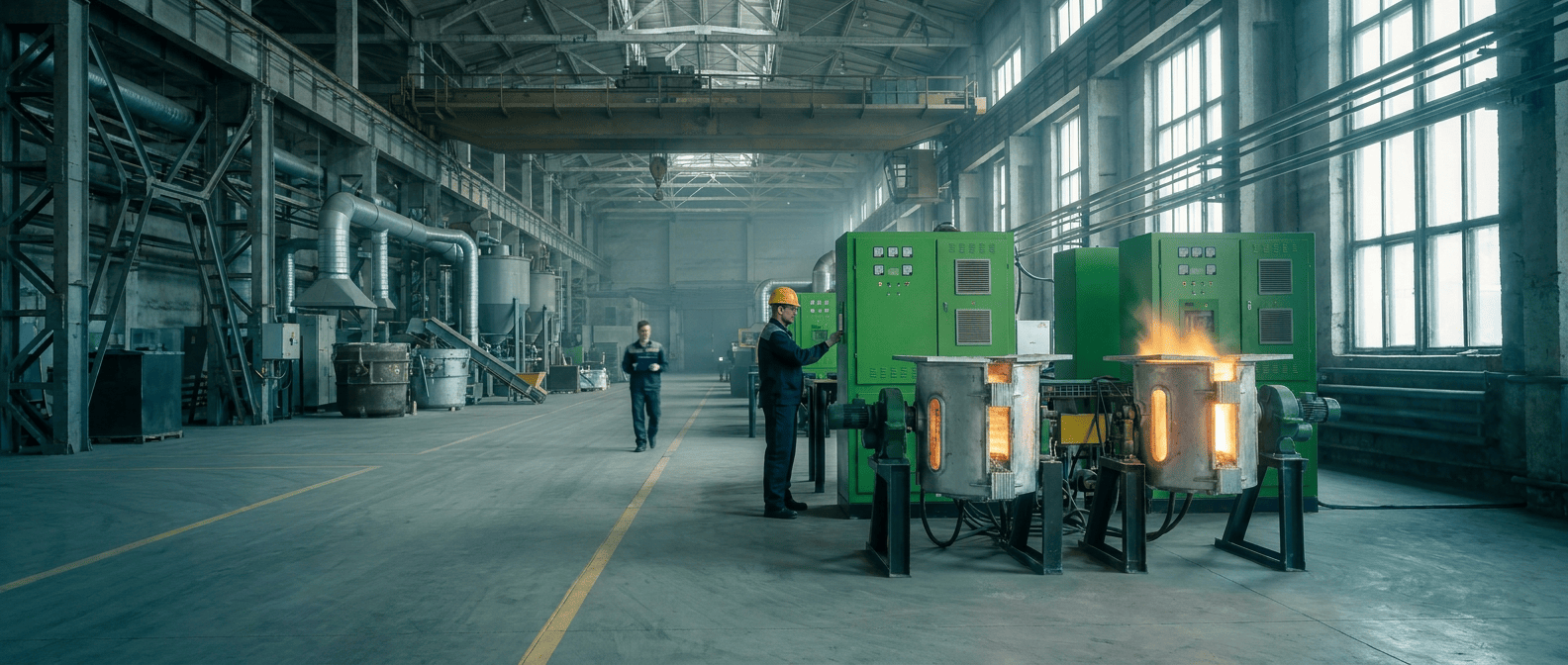
What is included in the supply of a melting system
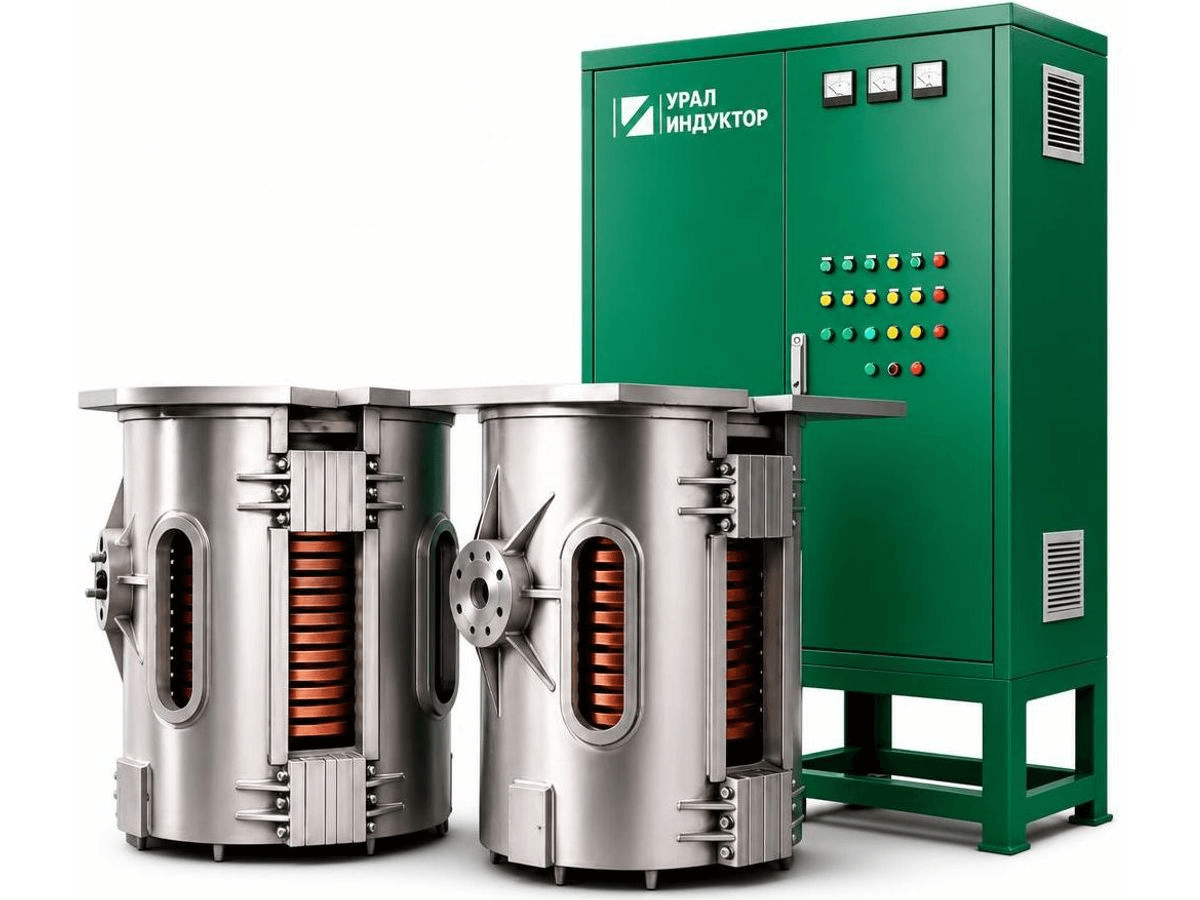
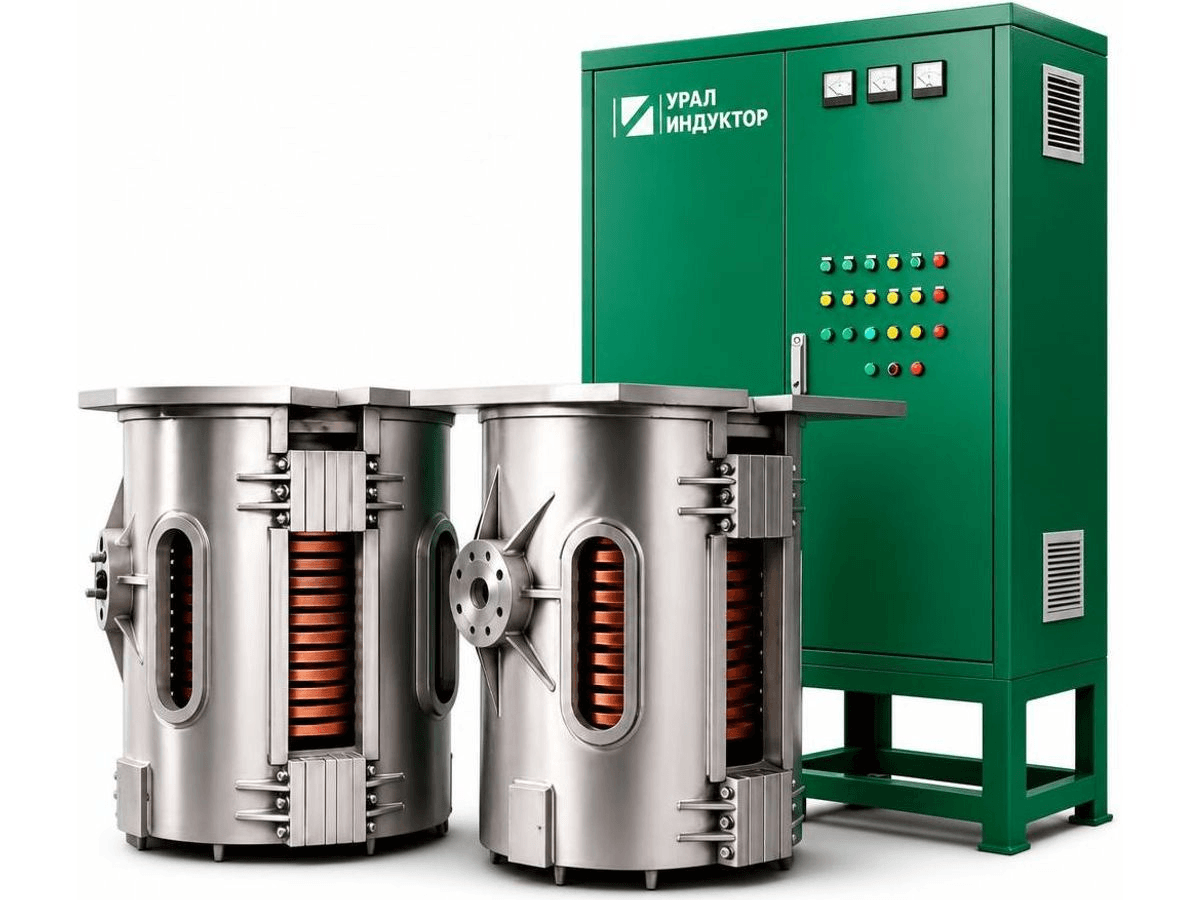
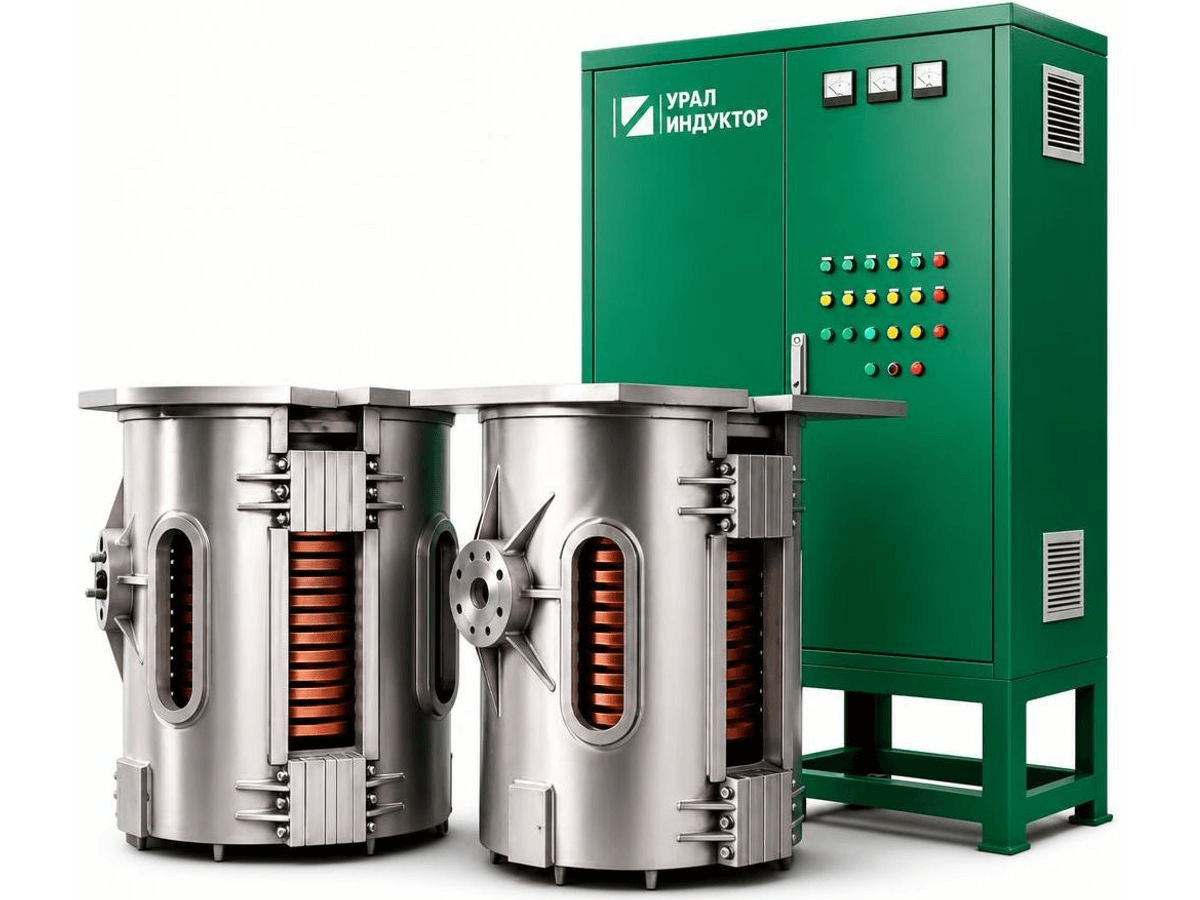
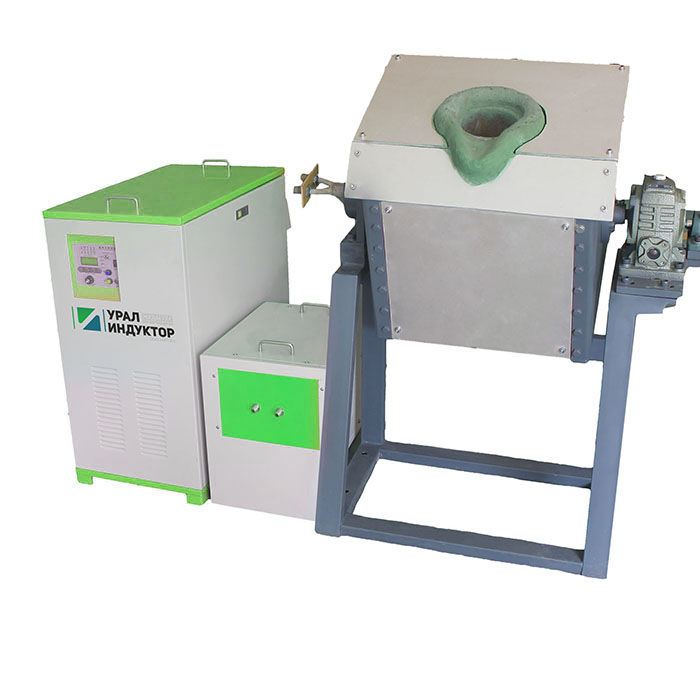
The basic configuration is the same for all capacities; only the design of the units differs. Options — weight control, pyrometer, automatic lid, smoke removal system, and spare crucible — are agreed separately per the technical specification.
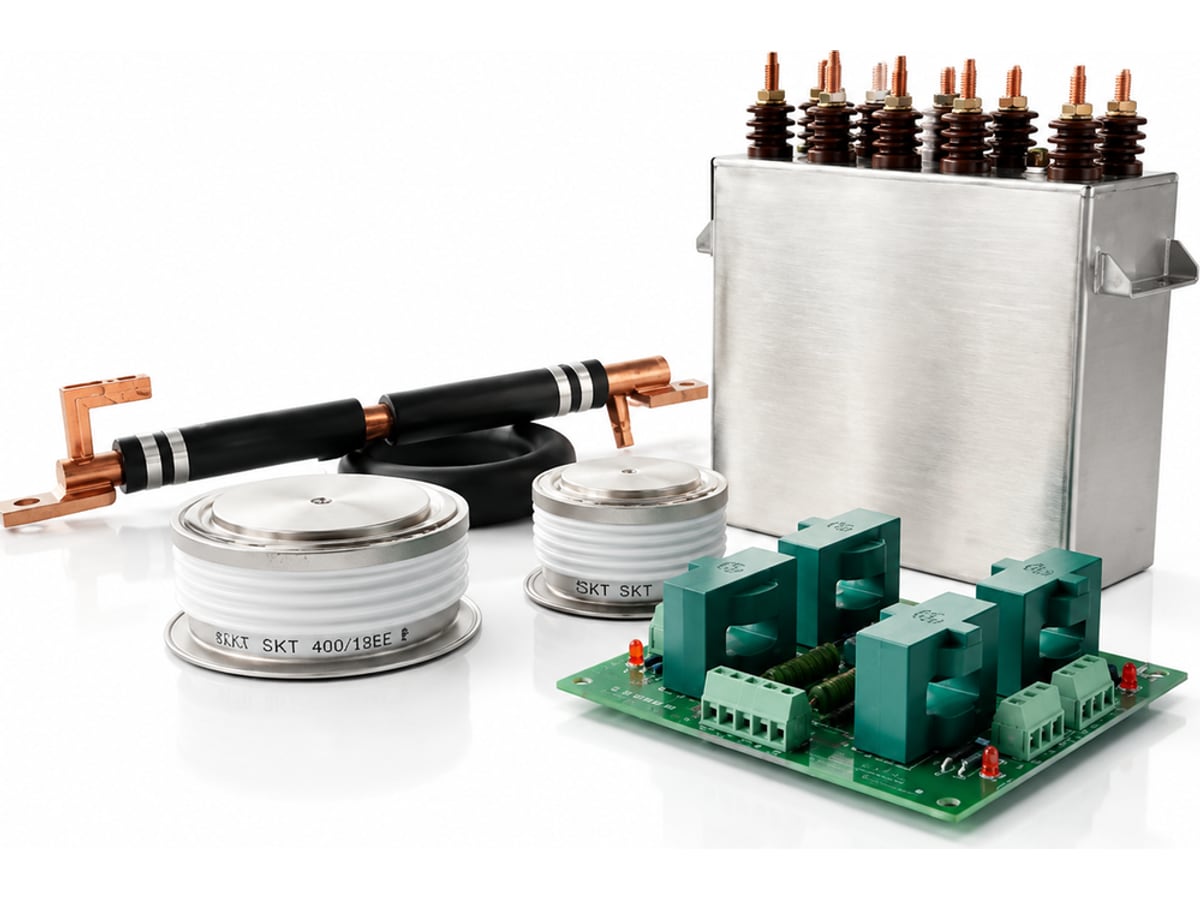
- Power frequency converter. TFC cabinet with Techsem thyristors for medium and large furnaces, or a transistor IGBT generator for small capacities. Microprocessor control with automatic resonant frequency tuning and a set of electronic protections. Separate section: power section spare parts.
- Capacitor bank in a cabinet. Electrothermal water-cooled capacitors in a protective metal cabinet, with water pressure and flow sensors and a busbar of increased cross-section for reactive power compensation.
- Melting unit with inductor. Crucible of the specified capacity in a welded steel or silumin housing — per the project. Inductor made of profiled copper tube with inter-turn insulation of increased heat resistance.
- Flexible water-cooled cables. Power cables of our own production for transmitting current from the bank to the inductor: they operate during furnace tilting without kinks or mechanical stress.
- Furnace tilting mechanism. Hydraulic pump station with double-acting cylinders and manual emergency backup, or an electromechanical gearbox — depending on the capacity and the layout of the site.
- Documentation, passports, and starting spare parts kit. Electrical and hydraulic diagrams, operator manual, crucible lining and sintering procedure, equipment passport, and starting set of spare parts.
transistor models: steel and cast iron 3–100 kg, copper 10–200 kg, aluminum 3–66 kg; small models for gold — from 1–2 to 8–10 kg;
- thyristor models of the catalog: from 100 kg to 15 t; larger or smaller garden, different power and automation are performed according to the technical task;
gear or hydraulic slope - by mass and mode of plums;
for thyristor complexes, the working circuit includes a frequency converter, a capacitor battery and one connected melting unit; for small and medium capacities, a typical execution with water-cooled cables 2 + 2, and for powerful complexes, the number of parallel cables increases; to reduce downtime, a second, backup node is recommended;
own assembly of frequency converter, capacitor batteries and water-cooled cables in Kazakhstan; official supply of transistor installations; warranty from 18 months.
Which technology to choose
Electricity consumption per ton of melt
This is not guaranteed consumption and is not the same norm for all furnaces. The flow rate at a particular melting point records the active energy meter. It is affected by loading, hot or cold start, share of shavings, moisture and pollution, slag, overheating, aging and operator skills.
Induction, arc, gas or resistance furnace
The induction furnace usually wins where compactness is needed, frequent brand changes, precise power management and there is no deep refining task in the furnace itself. For heavy-duty steel with intensive refining, arc technology may be preferable.
What is the melting complex
Standard working diagram of the thyristor complex: frequency converter - capacitor battery - one connected smelting unit. The basic supply includes one smelting unit. For small and medium capacities, four water-cooled cables of the internal high-frequency circuit are typically used two between the frequency converter and the battery and two between the battery and the node. For large and multi-pulse systems, the quantity is determined by calculation. The second node is the recommended reserve and a separate option; at the same time, one frequency converter feeds only one node. Water-cooled cables are not cores of network input 380/660 V.
- Frequency converter or transistor converter with power protections;
- inductor from a profiled copper tube with liquid cooling;
- futered melting unit or replaceable crucible;
- gearbox drive with manual duplication or hydraulic drive;
- reversible cooling system, calculated by thermal load;
- local hood and safe organization of loading and release.
What an engineer checks before choosing a model
Metal and alloy brands: they determine temperature, lining, crucible and slag mode.
Float mass and release: The full cycle and number of floats are considered, not just the melting time.
Furnace charge: size, bulk density, return share, shavings, pollution and moisture.
Power supply: voltage, power, transformer and cable routes.
Cooling: Thermal power, coolant quality, standby pump and emergency stock.
Planning: foundation, heights, loading equipment, bottling ladles and fences.
Automation: sensors, recipes, archive, energy accounting, ICS TP and locks.
Operating frequency: for thyristor furnaces, the frequency given in the tables is typical — by agreement, UralInduktor can manufacture a system with a different design value. For furnaces with a capacity of up to 250 kg, one of the possible and often preferred versions is 2,5 kHz, if it suits the metal, the size and density of the charge, the melting unit geometry, and the required bath movement.
Free engineering selection from 1 working day
We analyze the technical task free of charge, select the model and equipment, pre-calculate power, variable performance, cooling and basic communications. The data can be sent in a free form or attached a completed questionnaire.
Why you can not promise one performance for any metal
Kilowatts and crucible mass do not give finished performance. The real stroke is influenced by the heat capacity and melting point of the alloy, the initial temperature of the furnace charge, its largeness, hot or cold start, the duration of metallurgical operations and losses during release. Therefore, the pages indicate the nominal load and power, and the performance is calculated in the technical proposal for a given mode.
The nominal load of a thyristor furnace is the mass of one calculated melting in the design geometry of the lining, and not the hourly performance. As natural operational wear lining useful volume of the working cavity increases, and the actual load can become higher than nominal; in some cases, the increase reaches 30 %. This is not an overload permit: the allowable load is determined by the condition and safe thickness of the lining, the melt level, and the stock to the board.
Such an approach is more useful to the buyer and safer for the project: the main metallurgist receives clear initial assumptions, the main power engineer receives a real attached load, and the operation service receives requirements for cooling, lining and spare parts.
Cooling and electrical safety
Continuous circulation of coolant through the inductor and power electronics is a condition of power resolution. In the contour, prepared water or water-ethylene glycol or water-propylene glycol mixture is used. Glycol is used mainly at the risk of negative temperatures; its concentration is taken into account in thermal and hydraulic calculation. For the thyristor complex, a UIG cooling tower is usually calculated, for a compact transistor installation, an industrial chiller. Cooling is always indicated by a separate position.
The working pressure of cooling thyristor complex is 0,2 MPa (about 2 bar). The required flow rate, heat sink and control points are specified for the agreed execution; this is the working pressure, not the pressure of the pressurization. For transistor installations, there are separate passport pressure ranges.
For equipment of this class, separate grounding connections, switching, emergency shutdown, cable protection and work area fencing are designed. Coolant, currents, hot metal and hydraulics are considered together in the risk analysis.
The feeding line up to the frequency converter inlet is a separate three-phase input to L1, L2, L3 with PE. For models with 380 V and power frequency converter up to 500 kW, the cards show the calculated reference point for the total copper section to phase at the track to 30 m. Methodology: P / (1,732 × U × 0,93), stock 10 % by current, calculated density not exceeding 3 A/mm². This is not a finished cable scheme: the number of parallel cables and the nominal section of each housing is chosen by the owner ' s designer; for the permitted current of a particular cable, laying, temperature, harmonics, voltage drop, protection and short circuit current, the actual section may be increased. There is no numerical section on the website for powerful and design entries.
Why furnace has a 500 kg number of different cable orientations: the section determines the electric power and the voltage, not the mass of the float. At 380 V the V9 method УИ-0.5Т-400 for steel and cast iron has frequency converter 400 kW, calculated current around 654 A, current with a reserve of 10% about 719 A and a reference point of total copper about 240 mm² in phase. For УИ-0.5Т-350М for copper at 350 kW, the references are about 572/629 A and 210 mm²; for УИ-0.5Т-250А for aluminium at 250 kW = about 409/450 A and 150 mm². The number of parallel cables and the section of each housing shall be determined by the designer; the actual section may be increased by the conditions of the laying and permissible current of the selected cable.
Own power part and factory inspection
The Gross Metal Engineering TROP itself collects thyristor frequency converters (frequency converter), capacitor batteries and water-cooled cables in Kazakhstan. Small complexes often use MPU-6. control fees Means of measurement for which metrological verification is mandatory shall be used with valid verification.
performance check under load from 30 %;
element-by-element tightness check at 6 atm: inductors, collectors, reactor coils, connecting pipes, power thyristors liquid coolers and other cooled components; after assembly, the entire circuit is re-checked at 6 atm;
- two test transformers according to 630 kVA and one 1120 kVA at the production site;
- comprehensive verification of the power unit, protection, control, cooling and tilt; customer participation is possible in person or by video communication according to the agreed program.
Delivery, commissioning and service
The customer can choose equipment supply, installation supervision, installation, and commissioning, or bringing the melting area fully into operation. The full scope may include a survey, construction work, foundation, utilities, installation, trial melts, training, and handover for operation. The scope and acceptance criteria are fixed in the contract.
The production period of the serial thyristor complex is from 30 calendar days. The exact time depends on the performance and composition of the delivery and is fixed in the contract.
The engineering team has specialists with industry experience of more than 40 years. For large projects, Gross Metal Engineering LLP also attracts proven profile specialists with whom 13 has been cooperating for more than a year.
For selection, direct the metal brand, the weight of one melting, the replacement release, the parameters of the furnace charge, the voltage and the available power. Preliminary engineering selection, cooling calculation and commercial offer are performed free of charge - from 1 working day; the period of non-standard calculation depends on the completeness of the initial data.
Transparent structure of the commercial offer
The commercial proposal lists separately: 1) the furnace and the main agreed set; 2) the cooling system — УИГ for a thyristor system, or a chiller for a transistor unit; 3) on-site services — from installation supervision to a full range of construction and engineering work.
Payment, VAT and leasing
For running warehouse positions, prepayment from 10 % is possible, for large and individually designed installations - from 30 %. Leasing up to 5 years is issued through partner leasing companies; the decision, advance and schedule is determined by the leasing company. “Gross Metal Engineering” LLP operates under the general taxation system: equipment and services are supplied with VAT at the current rate and with closing documents.
Site preparation and layout in the shop
After the conclusion of the contract at the request of the customer, we place the complex free of charge on the provided workshop plan, indicate the service areas and characteristics of communications, provide recommended sketches of foundations and preparatory work. This is a layout task; working construction documentation is developed separately if included in the contract. Departure, measurements and consultations are possible by agreement.
The design is constantly improving, so the actual mass and dimensions of the equipment are reported on request for the selected execution.
Passports and documentation for the agreed execution are provided after the conclusion of the contract; the final set of passports and operational documentation is transferred with the equipment.
Diagnostics and modernization of furnaces of different manufacturers
"Gross Metal Engineering" LLP diagnoses, repairs and modernizes thyristor and transistor induction units of domestic and foreign manufacturers. If the furnace does not reach the specified mode, the power part, contour coordination, inductor, cooling, control and smelting technology are checked. The customer receives a written opinion with the reasons, priorities, works and components. Upon request, we attach to the conclusion a separate commercial offer for repair, replacement of nodes or modernization; it is not necessary to order subsequent works from Gross Metal Engineering LLP. A contractual guarantee is provided for the work performed.
Initial remote diagnosis is possible by photo, video, instrument readings and control messages; its volume and conditions are determined individually.