
Charging cart with vibratory charge feeding. The hopper, chute and undercarriage are selected to suit the furnace and the area layout.
Furnace charging carts
- Manufacturing and delivery time — in the commercial proposal
- Installation and commissioning — per contract
- 12 months warranty on supplied equipment
Description
We supply vibratory charging carts for feeding metal charge into melting furnaces. We select the hopper volume, the chute height and length, the travel arrangement for the furnace and the area layout.
| Appointment | Feeding metal charge into a melting furnace |
|---|---|
| Hopper capacity | 3, 5 or 7 m³ |
| Travel arrangements | A separate track to each furnace or a common track along a row of furnaces |
| Warranty | 12 months |
How the cart loads the furnace
The prepared charge is loaded into the hopper at the loading station. The cart travels on rails to the furnace, takes its working position and feeds the material along the vibratory chute. After charging, the chute is withdrawn from the furnace zone and the cart returns to the loading station.
The vibratory chute feeds the charge gradually. The piece size, permissible drop height and charging sequence are determined by the furnace requirements. Long scrap may hang up in the hopper, and wet charge remains hazardous with any feeding method.
- Hopper and chute: replaceable wear-resistant elements protect the working surfaces from impact and abrasion.
- Vibratory drive: provides charge feeding; the travel motor moves the cart itself.
- Undercarriage: brings the cart up to the furnace and back along the agreed rail track.
- Controls: manual and automatic modes, the link with the furnace system and the required interlocks are specified for the supplied configuration.
Longitudinal or transverse travel
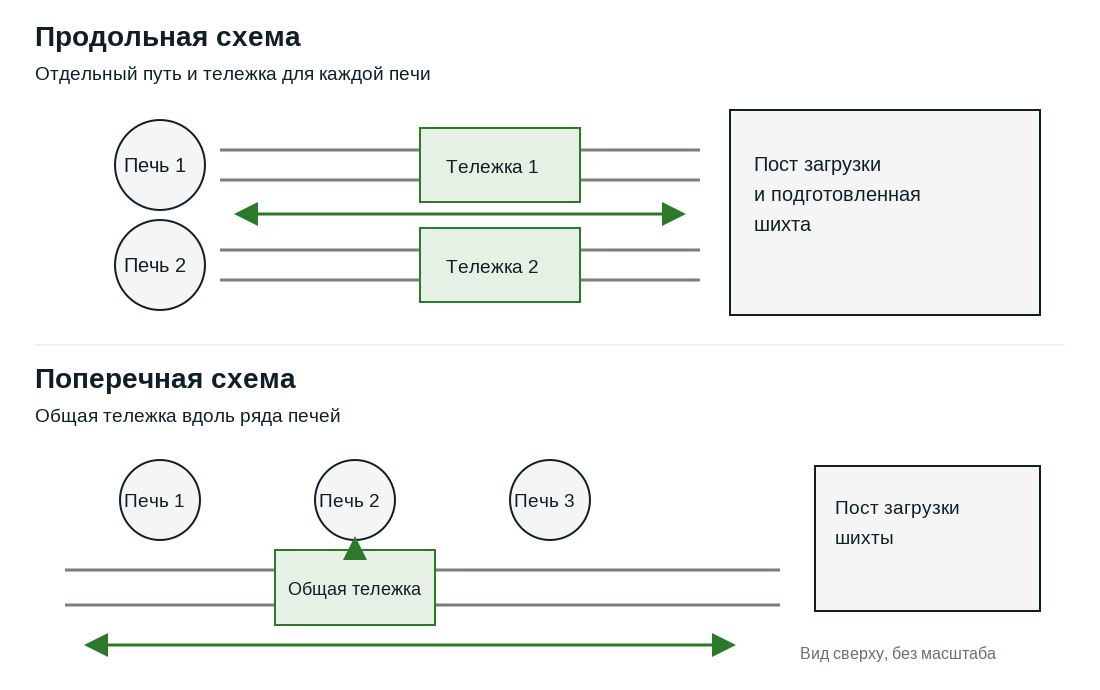
In the longitudinal arrangement, each furnace has its own approach track and a separate cart. Charging one furnace does not delay charging another. Each cart needs a loading station and space for the return run.
In the transverse arrangement, one cart moves along a row of furnaces. The chute is aligned with the charging opening of the selected furnace. The height, reach and method of introducing the chute are checked for each charging position.
A shared cart reduces the number of equipment units, but its stoppage affects several furnaces. When choosing the arrangement, check the charging sequence and access for repairs. The chute must not interfere with the furnace lid, the tilting mechanism, the extraction hood or ladle movement.
Capacity, feed and dimensions
In the table — three catalog versions for preliminary selection. Hopper volume is not equal to charge weight: cast iron charge and light scrap have different bulk densities. The parameters of the selected cart are recorded in the specification.
| Parameter | Hopper 3 m³ | Hopper 5 m³ | Hopper 7 m³ |
|---|---|---|---|
| Indicative furnace capacity, t | 3 | 5 | 10 |
| Charge feed, t/min | 1,5 — cast iron | 2 — cast iron | 2 — material not specified |
| Travel speed, m/min | 20, adjustable | 20, adjustable | 20 |
| Travel motor power, kW | 1,5 | 1,5 | 2,2 |
| Vibration motor power, kW | 2 × 2,2 | 2 × 3,7 | 2 × 5,5 |
| Dimensions, mm | 4200 × 1900 × 1800 | 5900 × 2300 × 2000 | 6100 × 2300 × 2400 |
| Track gauge per catalog, mm | 1500 | 1800 | 2000 |
The feed rate depends on the type of charge and the operating mode. The catalog dimensions and track gauge can be adapted to the site. The cart load capacity, chute outlet height, power supply and the exact method of measuring the track gauge must be confirmed against the drawing of the selected version.
What to check before ordering
Selection starts with the weight of a single charge and the composition of the charge. Then the hopper and the travel arrangement are determined. The production cycle includes hopper loading, travel, feeding and return: feeding productivity alone is not enough to assess the performance of the area.
To assess the load on the track, the mass of the equipment and the maximum mass of the charge are needed. These data cannot be obtained from the geometric hopper volume alone. The platform height, the rail layout, the space for the charging mechanism and access to the drives are checked separately.
- Furnace: capacity, charging opening diameter, rim height, lid and tilting mechanism.
- Charge: material, bulk density, maximum piece length, share of turnings and tendency to hang up.
- Layout: number of furnaces, distances between them, track length and crossings with transport.
- Productivity: charge weight, number of charges per hour and permissible feeding time.
- Automation: feeding permitted only when the cart and furnace are in a permissible position, stopping, end-position monitoring and actions on loss of power.
- Engineering conditions: power supply, extraction, rail track foundation, access for repair and cleaning.
Loading safety and maintenance
Only charge prepared in accordance with the furnace instructions is permitted for charging. Moisture, closed containers and unacceptable inclusions are hazardous regardless of the feeding method. The operator and the charging mechanism need access to the hopper without anyone being in the cart's path.
Before maintenance, the equipment is stopped and the energy sources are disconnected and locked out. The working surfaces of the chute, the mountings of the vibration motors, and the condition of the supports, wheels, rails and power feed are inspected. There must be no unprotected pinch zone between fixed structures and the moving cart. Specific measures and their frequency are set by the instructions for the supplied equipment.
Warranty and supply terms
Equipment warranty — 12 months. Supply from China. The cost, scope of supply, payment terms, manufacturing and delivery time, as well as installation and commissioning, are agreed in the commercial proposal and the contract.
Before ordering, we fix the technical specification and the version of the equipment. We confirm actual availability and lead time as of the date of the request. The photos show examples of designs; the final scope of supply is determined by the specification.
Questions before ordering
If you did not find an answer — call us, and an engineer will review your task.
Is this the roll-out hearth cart of a heat-treatment furnace?
No. The vibratory cart feeds metal charge into a melting furnace. A roll-out hearth moves the load in a heat-treatment furnace — that is different equipment.
Can one cart serve several furnaces?
Yes, if its design and the layout allow it. The transverse movement, the approach of the chute to each furnace and the charging sequence must be agreed.
Can a cart be chosen by furnace volume alone?
No. You also need the composition and weight of the charge, piece sizes, the charging opening, the feeding height, the layout and the required cycle.
Are replaceable working surfaces included in the set?
The cart has replaceable wear-resistant elements. The material of the working surfaces and the set of spare parts are stated in the specification.
Solutions for your production tasks
A full cycle of work with equipment for foundry, metallurgical and machine-building enterprises.
- 01Equipment selectionTailored to your process task
- 02Production area upgradeUpdating existing equipment
- 03Production start-upA new line of production
- 04Production supportStable operation of existing equipment
- 05Service and spare partsMaintenance and supply of components
Not sure where to start? Let's discuss your task.
Discuss your taskGet a proposal
Send the initial data and photos of the site. We will clarify any missing parameters and agree on a suitable version.
- Drawing or photos of the furnace and the charging opening
- Area plan with elevations and distances between furnaces
- Charge composition, charge weight and maximum piece size
- Number of charges per hour and the preferred control method
Let's discuss your task
- Main contact number+7 (775) 853-40-95
- Main office addressAstana, Saryarka district, Radisson hotel, office 4
- Office hoursMon–Fri, 9:00–18:00
We'll compare commercial proposals
and offer our own option.
Send us another company's proposal — we will compare the equipment list, configuration and cost.