
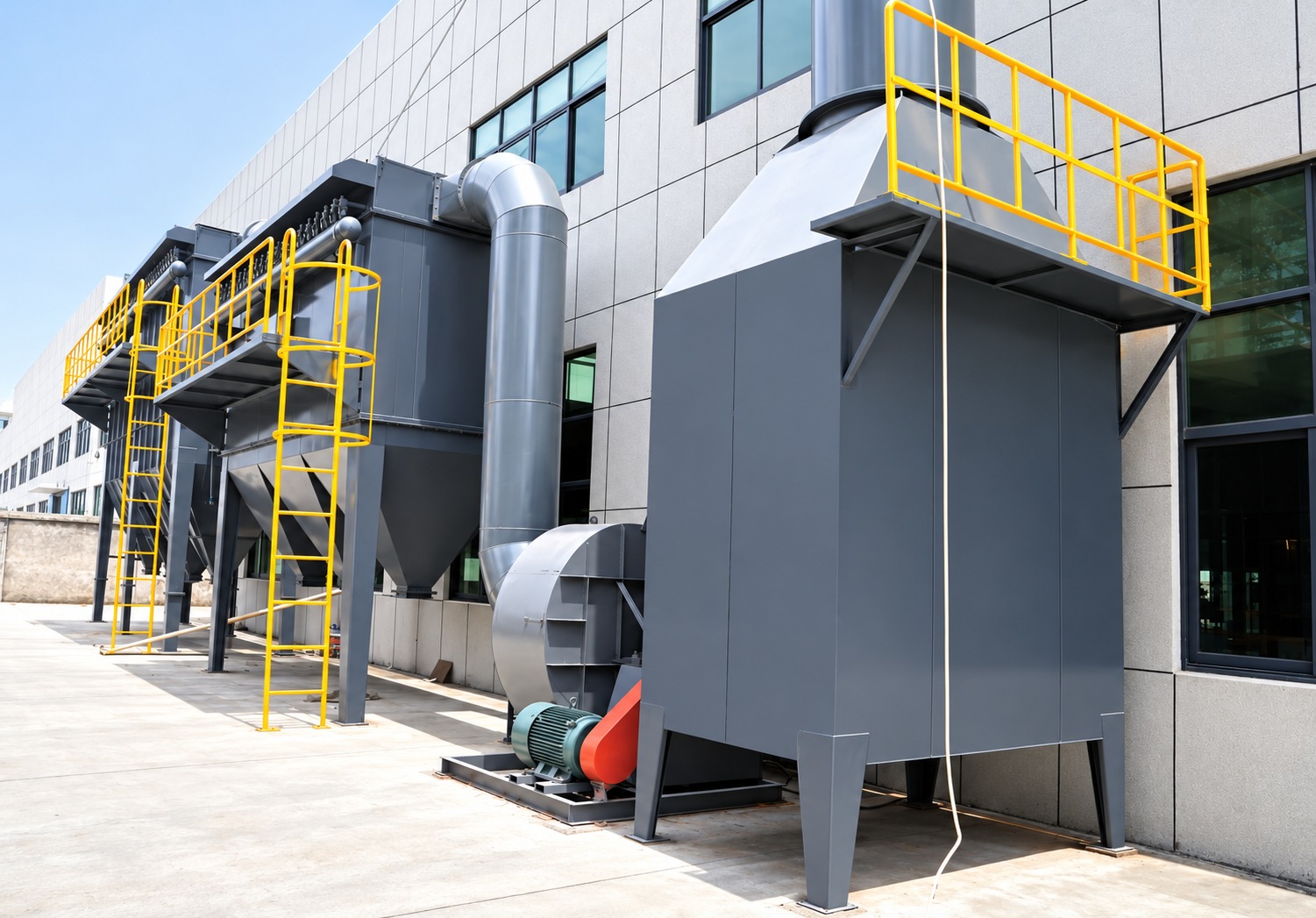
Bag dust collection system with ducts and a fan. The equipment composition is chosen according to the dust source and properties.
Gas cleaning and baghouse filters
- Manufacturing and delivery time — in the commercial proposal
- Installation and commissioning — per contract
- 12 months warranty on supplied equipment
Description
We select bag filters and gas cleaning systems for foundry areas. We take into account the flow rate and temperature of the stream, the dust properties, the operation of the extraction hoods, and discharge. Furnace gas cleaning and area dust extraction are calculated from different input data.
| Appointment | Foundry areas and dust removal from furnace gases |
|---|---|
| Catalog flow rate | 20 000–80 000 м³/ч |
| Filtration area | 384–1024 м² |
| Warranty | 12 months |
Area dust extraction and furnace gas cleaning are different tasks
At shakeout, sand reclamation, and shot blasting, enclosures and local extraction hoods collect dust-laden air. The flow rate depends on the size of the enclosure, the movement of material, and operator access. Even a correctly selected filter will not eliminate dust in the shop if the hood does not capture it at the source.
Hot gases, sparks, and fine particles may come from a melting furnace. The composition of the stream depends, among other things, on the charge. Upstream of a bag filter, cooling, separation of coarse particles, and additional cleaning stages may be needed. They are selected based on the stream parameters, not only on the furnace capacity.
A bag filter captures particles but is not a universal means of removing gaseous pollutants. Removal of carbon monoxide, nitrogen oxides, acid gases, and organic vapors requires a separate assessment and, if necessary, a different technology.
How a bag filter works
The contaminated stream enters the housing. Larger particles may settle into the hopper, while fine dust is retained on the filtering surface. The cleaned stream passes through the bag material into the clean chamber and then into the exhaust path.
Dust on the bags gradually increases the filter pressure drop. In the series presented, the bags are cleaned by sectional pulses of compressed air. The separated dust goes into the hoppers, from where it is discharged through the provided devices. The hoppers are not intended for long-term dust storage.
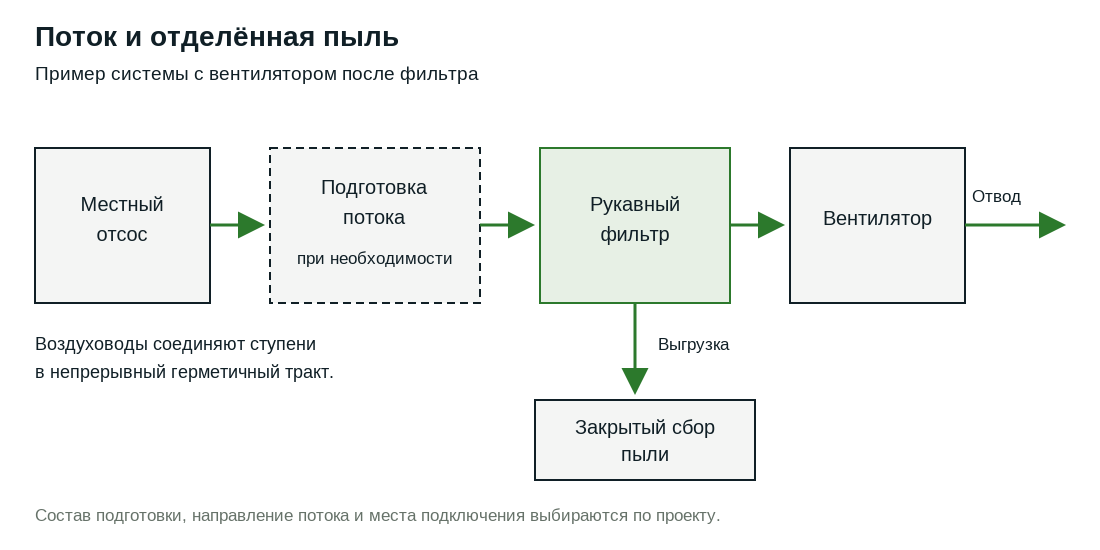
Flow rate and filtration area
The table contains catalog values of flow rate, filtration area, and number of bags. During selection, the temperature and the conditions to which the volumetric flow rate refers are clarified. The flow rate at operating conditions must not be replaced, without recalculation, by the flow rate normalized to standard conditions.
| Configuration | Flow rate, m³/h | Area, m² | Bags, pcs. |
|---|---|---|---|
| 1 | 20 000–25 000 | 384 | 384 |
| 2 | 30 000–35 000 | 512 | 512 |
| 3 | 40 000–50 000 | 640 | 640 |
| 4 | 50 000–60 000 | 768 | 768 |
| 5 | 70 000–80 000 | 1024 | 1024 |
The catalog filter pressure drop is 1200–1700 Pa. For fan selection, the pressure losses in the extraction hoods, ducts, other equipment, and the discharge path are additionally taken into account. The dimensions, fan power, permissible temperature, and bag material are confirmed for the selected system.
What data is needed for selection
The calculation requires information about the emission sources and their simultaneous operation. The operating and maximum temperature, humidity, dust composition and concentration, particle size, stickiness, and abrasiveness are specified. Sparks, dust combustibility, and gaseous impurities are assessed separately.
The filtration area is related to the flow rate through the specific load: v = Q / (60 × A), where Q — flow rate in m³/h, A — operating area in m², v — m/min. For example, 30 000 m³/h and 512 m² give about 0,98 m/min. This is only a calculated ratio, not confirmation of an acceptable mode for any dust. When a section is switched off, the operating area decreases.
- Extraction hoods and enclosures: position relative to the source, access for loading and servicing.
- Ducts: pressure drop, dust transport velocity, bends, inspection hatches, and wear protection.
- Preliminary stages: cooling, separation of coarse particles, and spark protection — if necessary.
- Filter material: permissible continuous and short-term temperatures, chemical compatibility, humidity, and dust properties.
- Bag cleaning: quality and consumption of compressed air, cleaning algorithm, and sectioning.
- Discharge: tightness, throughput, enclosed collection, and subsequent handling of the dust.
Temperature, condensation and fire risks
For the bag material, the permissible gas temperature is set for long-term operation and for short-term peaks. At the same time, the stream must not cool to the point of condensate forming on the bags and walls. Wet or sticky dust can make cleaning difficult and increase the pressure drop. The temperature mode is chosen taking into account the bag material and the gas composition.
Sparks and smoldering particles can damage the filter material. Combustible dust requires a separate hazard assessment: an ordinary bag filter must not be assumed to be explosion-proof by default. Measures for ignition prevention, protection, and isolation are agreed as part of the project. Water cooling also must not be added without checking the consequences for humidity and the dew point.
How the cleaning result is checked
The check includes the actual flow rate at the sources, the network balance, the pressure differential across the filter, and the operation of cleaning and discharge. A damaged bag, a leaking connection, or a clogged hopper can disrupt the operation of the entire system, even if the fan continues to run.
Capture efficiency at the source, dust separation efficiency in the filter, and the outlet concentration are different indicators. An efficiency value by itself does not confirm compliance with the requirements of a specific facility. The required concentration and the conditions for measuring it are fixed in the specification and checked at acceptance. Returning cleaned air to the room is not assumed without separate justification.
Emission requirements, measurement conditions, and acceptance parameters are agreed for the specific system. The result is evaluated at the specified flow rate, stream composition, and equipment operating mode.
What the system includes and what is agreed separately
The proposal fixes the scope of supply: the filter, bags and cages, the pulse system, the fan, dust discharge, and controls. Enclosures, ducts, additional stages, steel structures, the foundation, the exhaust path, and installation may be separate items.
For sand preparation and no-bake sand reclamation, a specialized dust collector can be considered. When several sources are connected to a common system, the simultaneity of operation, the characteristics of each stream, and the flow distribution between the branches are checked.
Warranty and supply terms
Equipment warranty — 12 months. Supply from China. The cost, scope of supply, payment terms, manufacturing and delivery time, as well as installation and commissioning, are agreed in the commercial proposal and the contract.
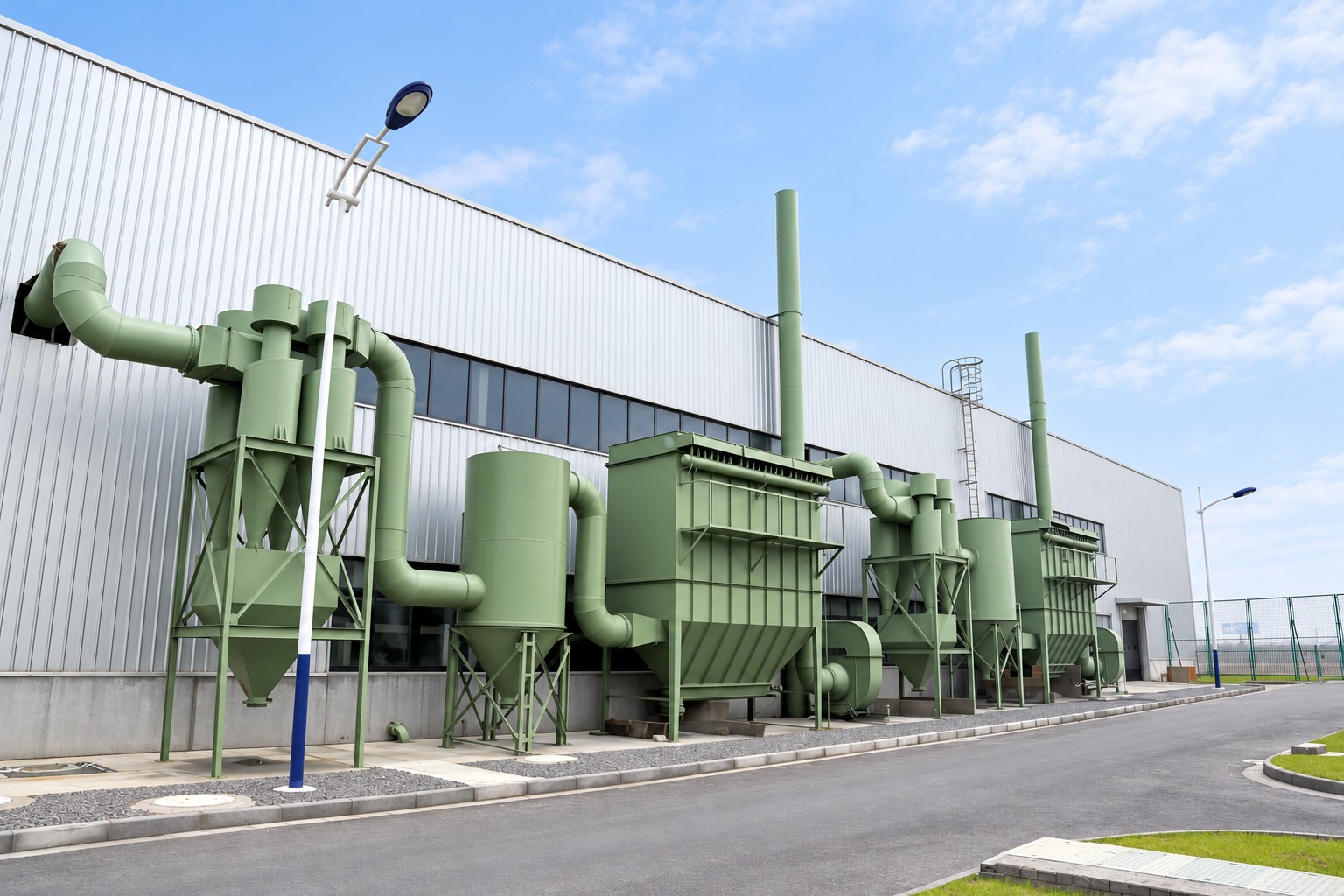
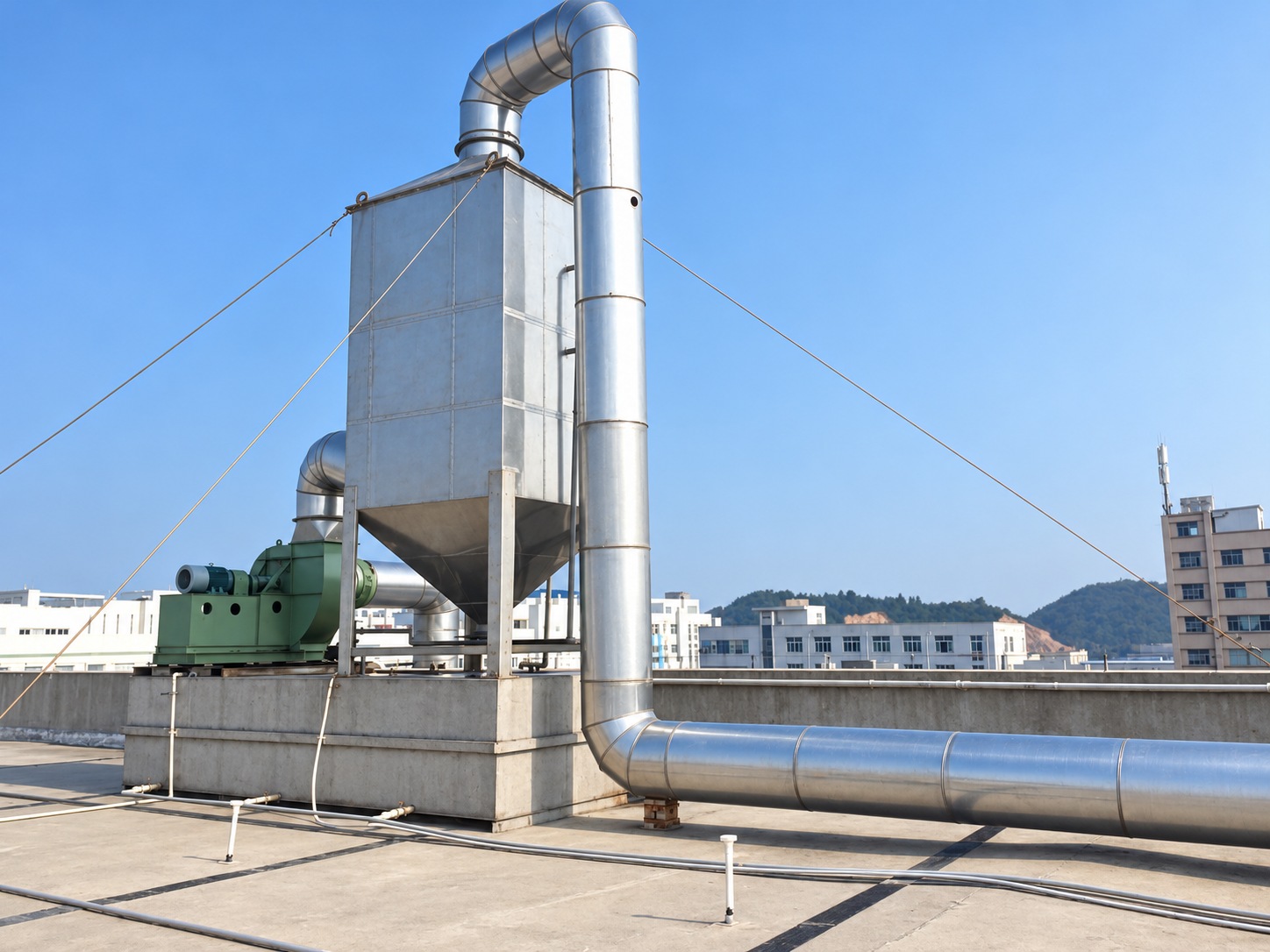
Before ordering, we fix the technical specification and the version of the equipment. We confirm actual availability and lead time as of the date of the request. The photos show examples of designs; the final scope of supply is determined by the specification.
Additional series of gas cleaning equipment
Series УИ-ФРИ, УИ-ЦП and УИ-СМ differ in cleaning method and equipment composition. The choice depends on the gas flow rate, temperature, and the properties of the contaminants.
Questions before ordering
If you did not find an answer — call us, and an engineer will review your task.
Is a bag filter suitable for any melting furnace?
No. The stream characteristics and checking of the temperature, dust composition, humidity, sparks, and possible gaseous impurities are required. Stream conditioning and additional stages may be needed.
Can a system be selected by tons of metal per hour?
Furnace productivity helps to assess the task, but it is not enough to calculate the gas flow rate. The extraction scheme, operating modes, and stream parameters are required.
Is it enough to know only the fan flow rate?
No. A fan is selected for the operating point based on the flow rate and the total pressure drop of the system. The extraction hoods, ducts, equipment, and outlet must be taken into account, as well as the change in the filter's pressure drop.
Does the filter remove odors and gaseous impurities?
A bag filter separates particles, not gaseous impurities. To remove odors and gases, additional stages are selected according to the stream composition.
Solutions for your production tasks
A full cycle of work with equipment for foundry, metallurgical and machine-building enterprises.
- 01Equipment selectionTailored to your process task
- 02Production area upgradeUpdating existing equipment
- 03Production start-upA new line of production
- 04Production supportStable operation of existing equipment
- 05Service and spare partsMaintenance and supply of components
Not sure where to start? Let's discuss your task.
Discuss your taskGet a proposal
Send the initial data and photos of the site. We will clarify any missing parameters and agree on a suitable version.
- Source of dust or furnace gases and its operating modes
- Flow rate and temperature of the stream, including peak values
- Composition, concentration, and properties of the dust, humidity, and impurities
- Layout plan, duct lengths, and connection points
- Requirements for the outlet stream and scope of supply
Let's discuss your task
- Main contact number+7 (775) 853-40-95
- Main office addressAstana, Saryarka district, Radisson hotel, office 4
- Office hoursMon–Fri, 9:00–18:00
We'll compare commercial proposals
and offer our own option.
Send us another company's proposal — we will compare the equipment list, configuration and cost.