
Magnesite crucibles for melting steel
Magnesite crucibles made of fused magnesia (MgO) for melting steel in transistor induction furnaces. Long-term operating temperature — 1700–1800 °C. The table lists eight standard sizes with a capacity of 3–100 kg for steel. For replacement, the geometry of the melting unit, the steel grade and the melting conditions are taken into account.
Material and temperature regime
| Parameter | Value |
|---|---|
| Material | Fused magnesia (MgO) |
| Refractory type | With pronounced basic properties |
| Long-term operating temperature | 1700–1800 °C |
| Melting point of MgO, for reference | 2852 °C; not the working temperature of the crucible |
For long-term operation of this series, a range of 1700–1800 °C is specified. The specific mode depends on the steel grade, the slag composition, and the melting time. The melting point of MgO is 2852 °C — a characteristic of the main component, not the permissible operating temperature of the finished crucible.
When a magnesite crucible is chosen
Magnesite crucibles are chosen for melting steel when contact of the melt with a graphite crucible, and the associated carbon pickup, must be avoided. The main refractory is MgO — therefore the composition of the slag, and not only of the metal, matters when selecting a crucible.
For carbon, tool, alloy, and stainless steel, the exact grade, working temperature, and additives are specified. When switching from one steel to another, compatibility is checked again. Melt purity requirements and the holding mode may change the choice of refractory grade.
For cast iron and for nickel and cobalt alloys, the suitability of the material is checked separately against the chemical composition and the melting mode. Approval for one steel grade does not extend to other alloys. The nominal capacities of 3–100 kg in the table apply to steel only.
What distinguishes this series from the corundum series
Magnesite and corundum — different oxide materials. Small corundum (alundum) crucibles with lids cannot be regarded as a replacement for these products based on outward similarity: the dimensions, design, and application requirements differ.
Capacity and dimensions
| Capacity for steel, kg | Size designation, mm |
|---|---|
| 3 | 91(65) × 180(165) |
| 5 | 119(95) × 140(115) |
| 10 | 130(106) × 225(200) |
| 18 | 150(120) × 300(285) |
| 25 | 175(140) × 320(300) |
| 35 | 210(175) × 310(270) |
| 50 | 220(178) × 325(285) |
| 100 | 250(205) × 515(475) |
Dimensions for selection
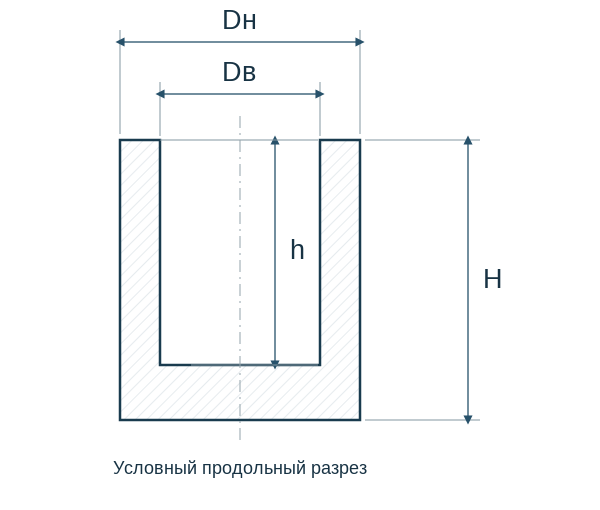
- Dн
- outer diameter
- Dв
- inner diameter
- H
- overall height
- h
- inner depth to the bottom
H is measured from the top end to the outer surface of the bottom, h — from the top end to the bottom of the inner cavity.
The diagram shows the parameters to be measured. The designations from the table, including the values in parentheses, are checked against the dimensional drawing of the product.
Open a larger diagram ↗Capacity is given for steel. The outer and inner dimensions, and the height and depth of the cavity, are confirmed against the drawing of the selected version.
Selecting a magnesite crucible
Check the outer diameter, height, bottom shape, and supporting surface. The inner diameter and cavity depth are needed to estimate the working volume. Installation clearances and the installation method must match the furnace design.
The material is selected taking into account the steel grade, slag composition, and working temperature. The MgO designation indicates the base of the material; the mass fraction of magnesium oxide, porosity, and other requirements are specified for a particular version.
Order data
- Furnace model and drawing, or dimensions of the installed crucible.
- Steel grade, weight of a single melt, and working temperature.
- Slag composition, fluxes used, and other additives, if any are used.
- Quantity of products and material requirements.
Before the first melt, the crucible is prepared according to the instructions for the selected material. The drying and heating procedure must be obtained together with the technical requirements for the product.