
Corundum (alundum) crucibles with lid
Corundum (alundum) crucibles with lids are made of ceramic with an Al₂O₃ content of 99%. Volume — 100, 150, 200, 300, 500 and 950 mL. Long-term operating temperature — 1600–1650 °C, short-term — about 1700 °C. The crucibles are suitable for heating samples and heat treatment of compatible materials. For melting metal, its composition and the furnace mode are checked.
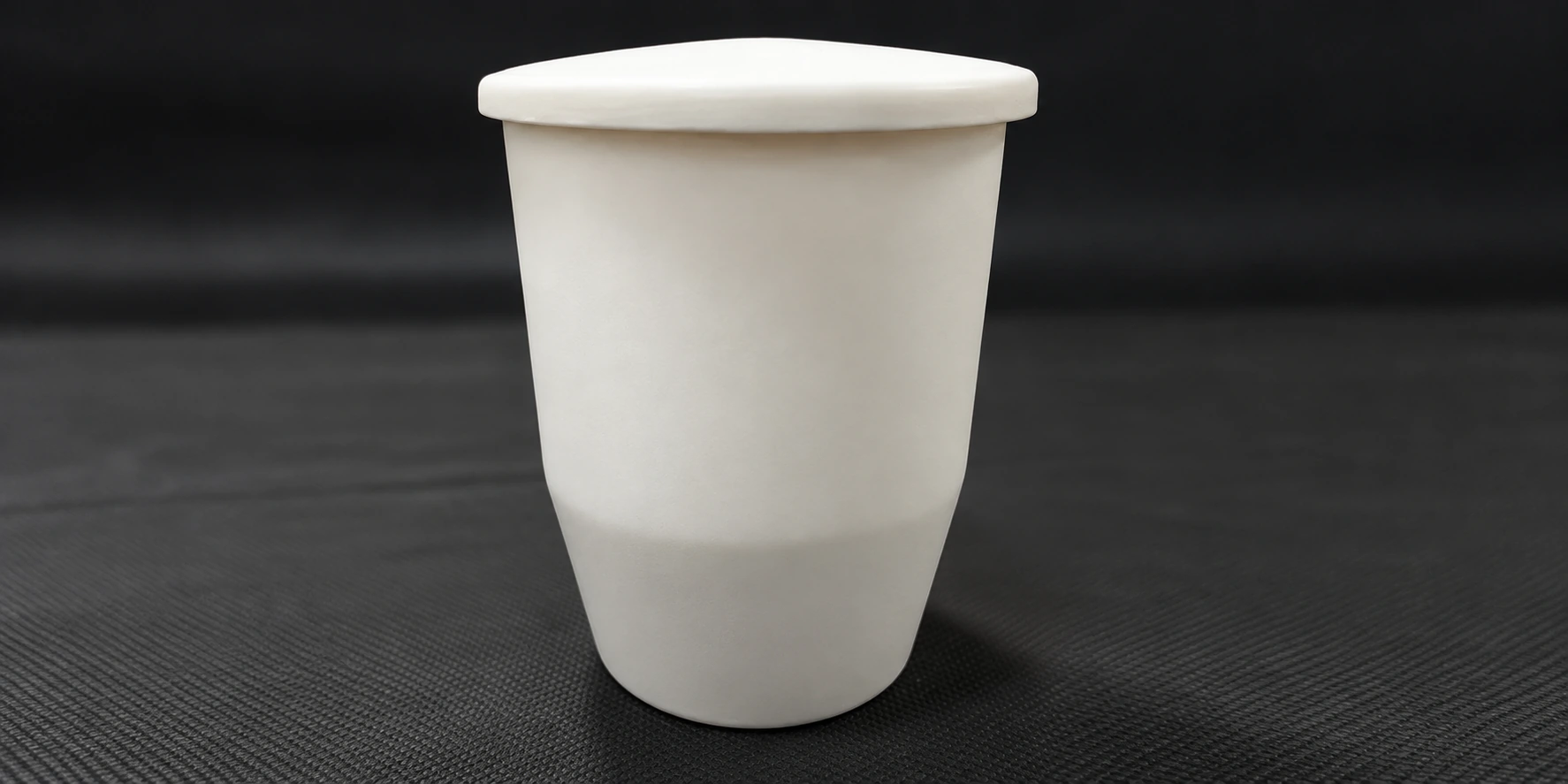
Material and operating temperature
| Parameter | Value |
|---|---|
| Material | Corundum (alundum) ceramic |
| Al₂O₃ content | 99% |
| Refractory type | Neutral |
| Long-term operating temperature | 1600–1650 °C |
| Short-term operating temperature | About 1700 °C |
| Short-term holding time | Agreed for the specific process |
Short-term heating to about 1700 °C does not replace the long-term mode of 1600–1650 °C. The holding time and the heating and cooling rates are selected taking into account the contents of the crucible, the atmosphere and the operating conditions.
Corundum is classed as a neutral refractory. This does not mean resistance to all melts: compatibility with fluxes, salts and other substances is checked for the chosen process.
Volume, dimensions and weight
| Volume, mL | D, mm | d, mm | H, mm | Crucible, g | Lid, g | Supply scope |
|---|---|---|---|---|---|---|
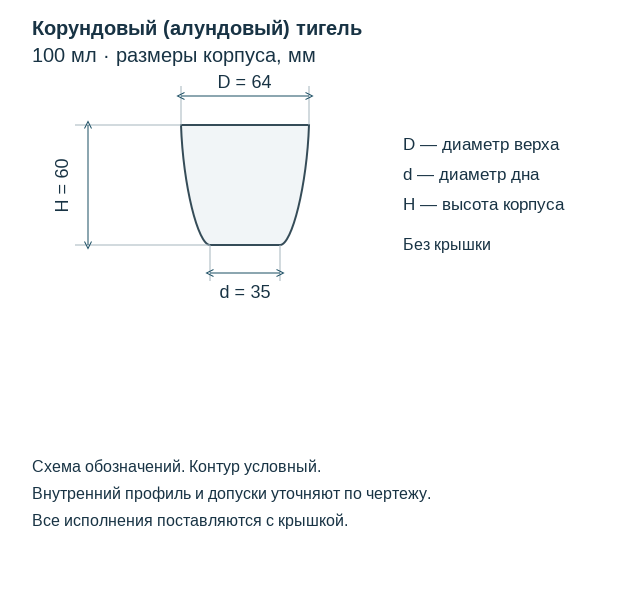
| 100 | 64 | 35 | 60 | 122 | 61 | Included |
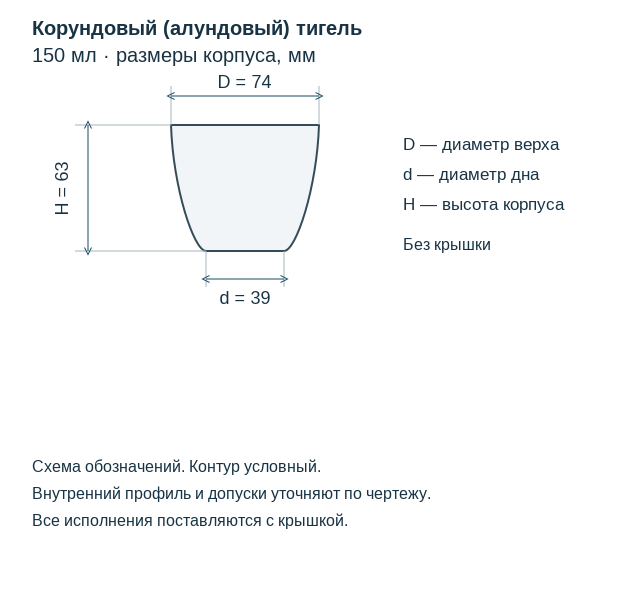
| 150 | 74 | 39 | 63 | 142 | 72 | Included |
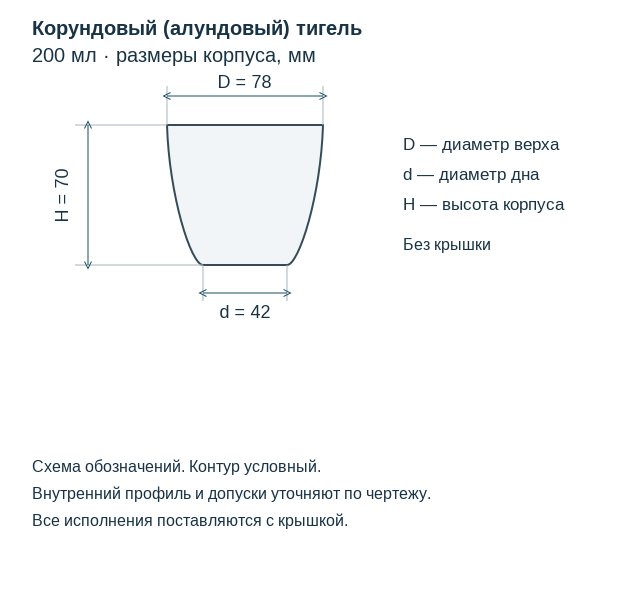
| 200 | 78 | 42 | 70 | 175 | 86 | Included |
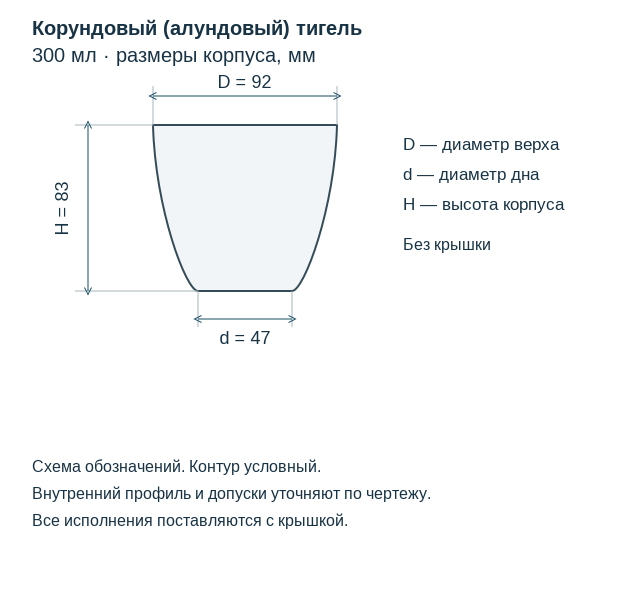
| 300 | 92 | 47 | 83 | 279 | 122 | Included |
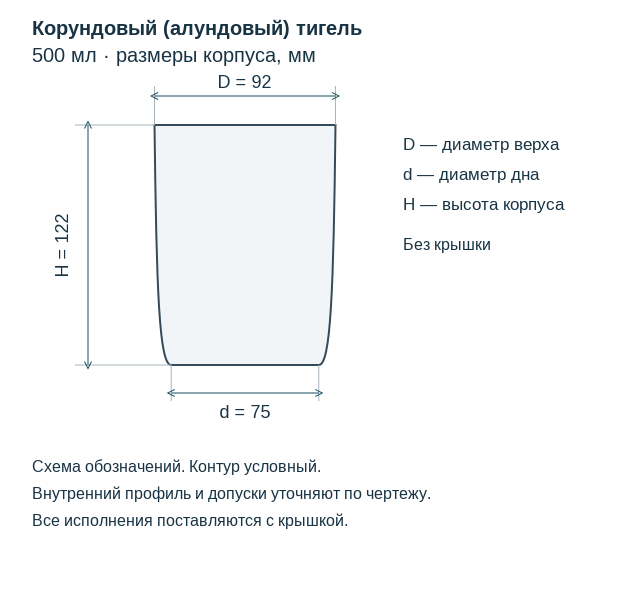
| 500 | 92 | 75 | 122 | 563 | 123 | Included |
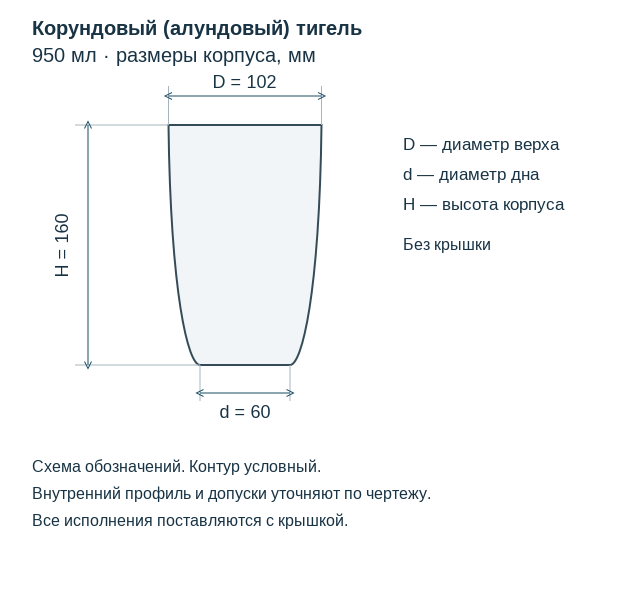
| 950 | 102 | 60 | 160 | 470 | Clarified | Included |
On a phone, the table can be scrolled left and right.
D — top diameter, d — bottom diameter, H — body height without the lid. The weight of 470 g for the 950 mL version refers to the crucible shown; the lid weight is specified separately. Dimensions and weight are nominal; tolerances are agreed when ordering.
Shape and dimensions of the versions
Corundum (alundum) crucible 100 ml with lid
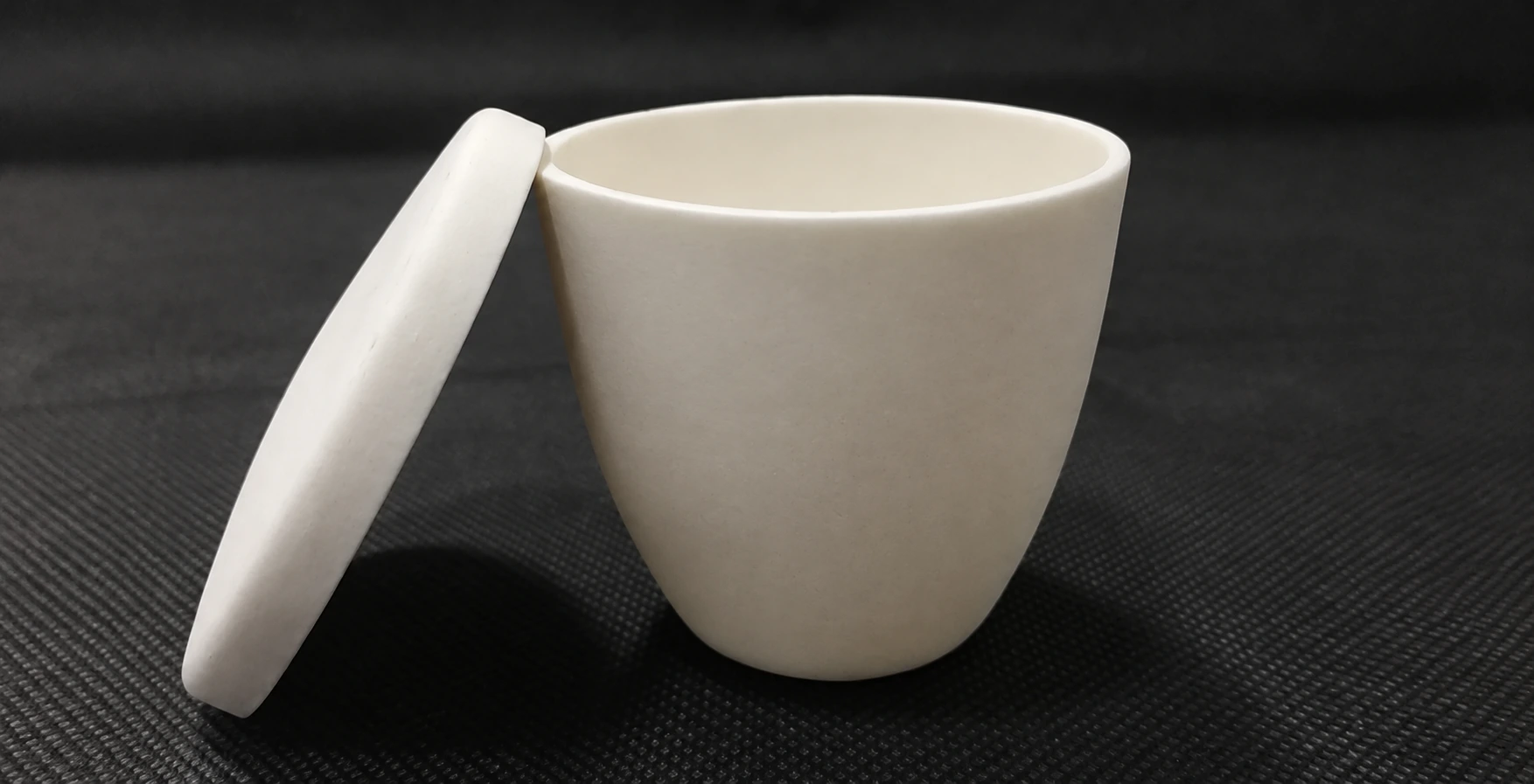
Corundum (alundum) crucible 150 ml with lid
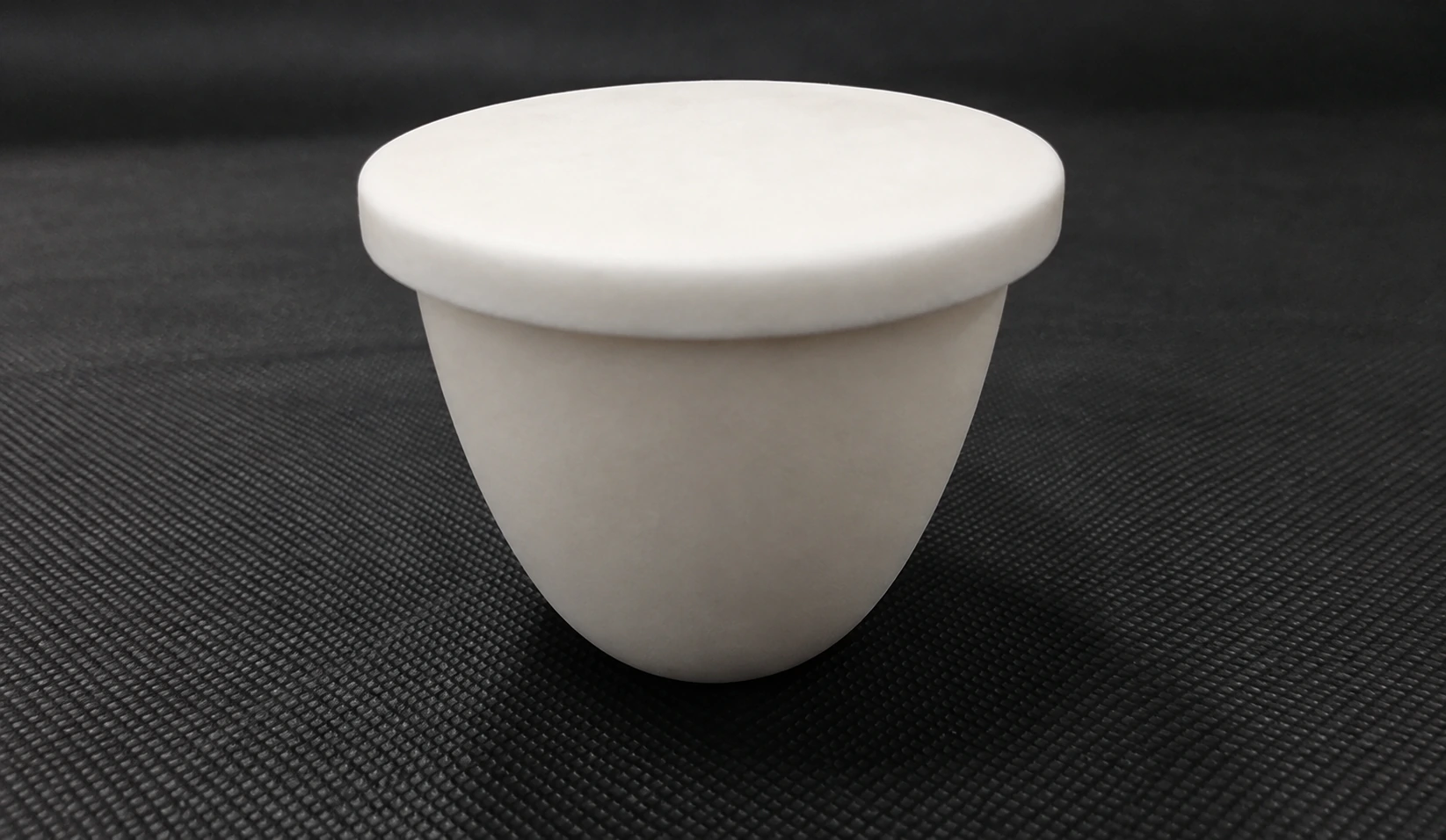
Corundum (alundum) 200 mL crucible with lid
Corundum (alundum) crucible 300 ml with lid
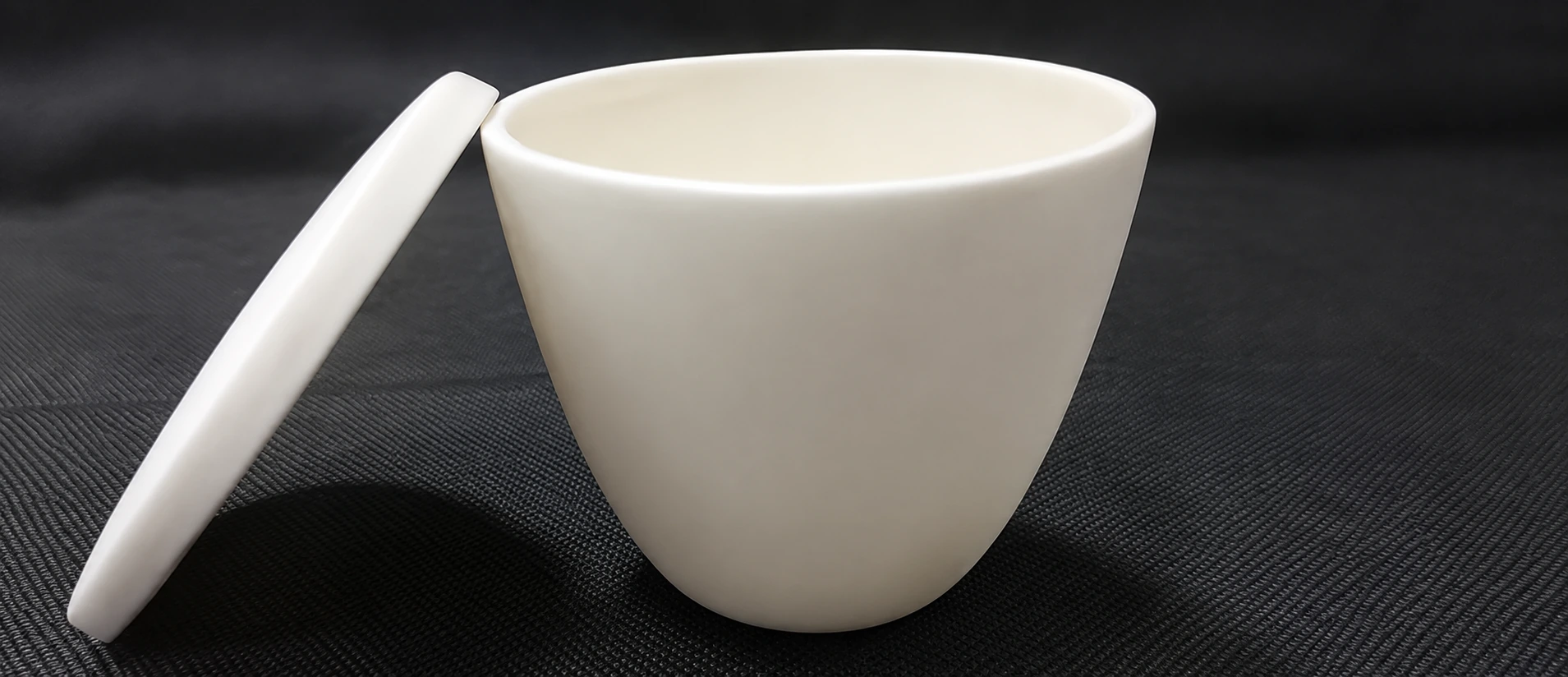
Corundum (alundum) crucible 500 ml with lid
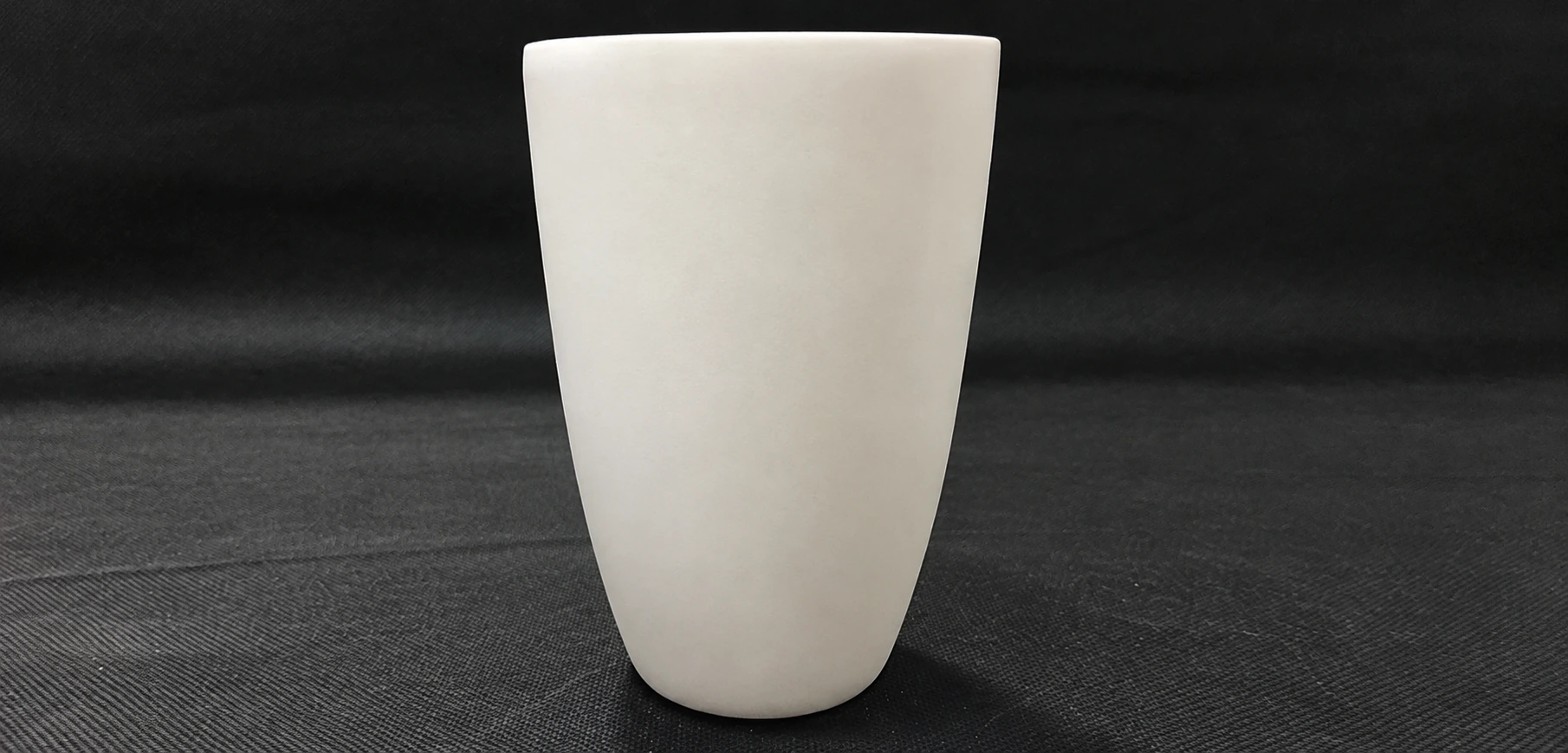
Corundum (alundum) crucible 950 ml with lid
Additional dimensions of lids and bottoms
| Crucible, mL | Lid: outer Ø, mm | Lid seating Ø, mm | Lid height, mm | Crucible bottom thickness per diagram, mm |
|---|---|---|---|---|
| 100 | 78 | 72 | 9 | 3 |
| 150 | 84 | 77 | 9 | 3,5 |
| 200 | 90 | 84 | 12 | 3,5 |
| 300 | 103 | 96 | 10 | 3 |
| 500 | 103 | 96 | 10 | 5 |
On a phone, the table can be scrolled left and right.
The bottom thickness does not specify the wall thickness along the entire height. For 950 mL, the diagram shows a 4 mm bottom; the lid dimensions are not given. The height of the assembled set cannot be obtained by simply adding H and the lid height without checking the fit.
What corundum and alundum crucibles are used for
In this catalog, the names «corundum» and «alundum» refer to the same series of alumina-based ceramic with an Al₂O₃ content of 99%. For analytical work, the composition of impurities, the porosity and the ceramic grade are additionally agreed.
Heating and calcining of samples
The crucible serves as a container for the heat treatment of powders and samples in a laboratory furnace. It is selected by the sample volume, temperature, atmosphere and chemical compatibility. For analytical work, possible contamination of the sample with ceramic impurities is also taken into account.
Heat treatment of ceramics and small samples
Corundum products are used as containers for firing and sintering compatible materials. The tall 500 and 950 mL versions differ from the cup-shaped 100–300 mL ones: when selecting, check the chamber height, tool access and the stability of the setup.
Laboratory melting of metals
Industrial corundum materials are used, among other things, for melting steel, palladium and some nickel and cobalt alloys. For this 100–950 mL range, use in such melting is agreed separately: the ceramic grade, temperature, atmosphere and metal composition are needed. The general field of application of corundum does not replace verification of a specific crucible.
For copper, gold, silver and their alloys, the possibility of use is also assessed from the process conditions. If the task is ordinary foundry melting of non-ferrous metals — compare Graphite, clay-graphite and silicon carbide crucibles.
What to check before use
Temperature and chemical environment. For this series, 1600–1650 °C is specified for long-term operation and about 1700 °C for short-term operation. The permissible mode is checked together with the composition of fluxes, salt melts and slag. Corundum must not be assumed to be resistant to any alkaline or fluorine-containing reagent.
Induction heating. Aluminum oxide — an electrically insulating ceramic. Such a crucible does not replace a graphite heating element: in an induction unit, the energy must be received by the metal or by a specially provided conductive heater. Whether it can work depends on the entire design of the unit.
Heating and cooling. Avoid sharp temperature changes, impacts and contact of the hot product with moisture. The heating and cooling rate and the holding time are set for the chosen ceramic and furnace. There is no single schedule for all volumes.
Working volume. A load in kilograms cannot be assigned from the rating in milliliters without data on the metal and the working volume. When melting, leave free space for the expansion of the melt, stirring and process additions.
Delivery set and size selection
All six sizes are supplied with a lid. The lid covers the top opening, but it is not an airtight closure and does not create a controlled atmosphere. A suitable furnace is needed for work in a protective gas.
The 950 mL crucible is shown in the photo without the lid; the lid is included in the delivery set. Its dimensions and weight are agreed when ordering. The body profile and tolerances are confirmed from the drawing of the selected version.
The 300 and 500 mL versions have the same top diameter of 92 mm, but different height and base. The 300 mL has a height of 83 mm and a bottom diameter of 47 mm; the 500 mL — 122 and 75 mm. For replacement, always check all three dimensions.
Questions about corundum (alundum) crucibles
Corundum and alundum — are these different crucibles?
In this catalog, both names refer to the same range of ceramic crucibles with an Al₂O₃ content of 99%. To order, state the volume and dimensions. The long-term operating temperature of this series — 1600–1650 °C, short-term — about 1700 °C.
Can a graphite crucible be replaced with a corundum one?
Only after checking the melting unit. The materials interact differently with the melt and the heating system. It is especially important to check the induction heating scheme and the dimensions of the seating.
What is the volume of the tall crucible: 900 or 950 mL?
This size range offers a 950 mL crucible with body dimensions of 102 × 60 × 160 mm: top diameter × bottom diameter × height. When ordering, use the 950 mL rating.
Can the lid be considered part of the stated height?
No. The height H refers to the crucible body without the lid. The overall height of the assembled set is checked separately if the free space above the crucible is limited.