
Graphite crucibles with silicon carbide additive
A separate range of graphite-containing crucibles with silicon carbide (SiC) added, for melting non-ferrous metals. The table lists 23 versions. To order, state the standard size, geometry and material requirements.
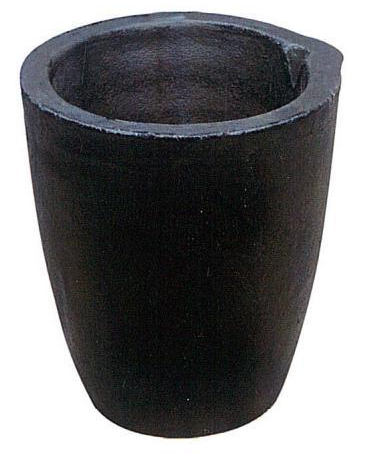
Composition with SiC addition and choosing a replacement
When replacing a crucible of this series, check the dimensions and composition: the material contains graphite and silicon carbide. The SiC values from the table apply to this series; they must not be transferred to other silicon carbide crucibles.
For copper, brass, bronze and aluminum alloys, the version is selected together with the furnace. For Al–Mg and aluminum bronzes, the composition of the melt and fluxes is especially important. When melting gold and silver, the permissible level of impurities is specified.
The presence of SiC does not make it possible to determine the service life or power consumption in advance. To select a more durable replacement, information on the wear of the previous crucible is needed: where the wall failed, the charging sequence and the holding time.
Crucible dimensions
How to read the dimensions
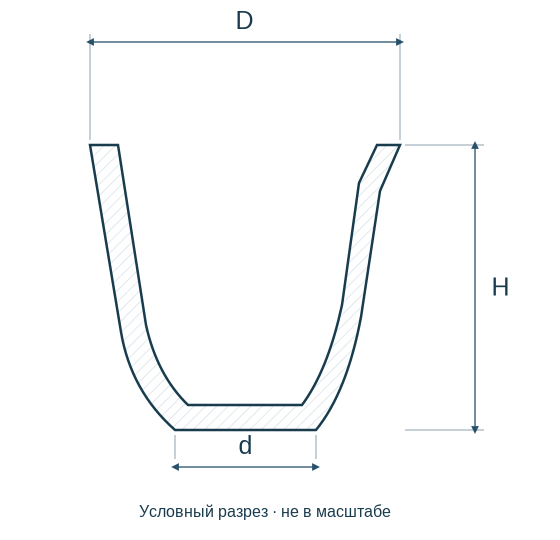
- D
- outer diameter at the top
- H
- overall height
- d
- outer diameter of the bottom
Dimensions in millimeters. The diagram shows the designations; the profile and tolerances are agreed according to the drawing.
Open a larger diagram| Size | D, mm | H, mm | d, mm |
|---|---|---|---|
| 2 | 95 | 114 | 66 |
| 6 | 137 | 176 | 88 |
| 8 | 159 | 188 | 108 |
| 10 | 167 | 201 | 113 |
| 12 | 175 | 214 | 118 |
| 16 | 188 | 232 | 127 |
| 18 | 195 | 246 | 132 |
| 20 | 201 | 260 | 137 |
| 25 | 214 | 285 | 146 |
| 30 | 222 | 295 | 153 |
| 35 | 230 | 305 | 159 |
| 40 | 242 | 315 | 165 |
| 50 | 253 | 314 | 178 |
| 60 | 282 | 356 | 190 |
| 80 | 306 | 387 | 210 |
| 100 | 330 | 400 | 232 |
| 120 | 340 | 444 | 238 |
| 150 | 370 | 461 | 259 |
| 200 | 408 | 501 | 279 |
| 250 | 430 | 557 | 285 |
| 300 | 454 | 583 | 292 |
| 400 | 526 | 661 | 318 |
| 500 | 531 | 713 | 318 |
On a phone, the table can be scrolled left and right.
D — outer diameter at the top, H — overall height, d — outer diameter of the bottom. The numbers 2–500 denote standard sizes, not capacity in kilograms. The inner profile and working volume are agreed per the drawing.
Material properties
| Indicator | Value |
|---|---|
| Refractoriness, °C, at least | 1635 |
| Carbon content, %, at least | 41,4 |
| Open porosity, %, at most | 32 |
| Bulk density, g/cm³, at least | 1,7 |
| SiC content, %, at least | 24 |
The figures given apply to this series. For other graphite and silicon carbide crucibles, the characteristics are checked separately. Refractoriness does not replace the permissible operating temperature. The conditions of use are determined by the metal, fluxes, atmosphere and heating method.
How to avoid mistakes when replacing
Different series may share the same number and outer dimensions. For example, versions 250, 400 and 500 also exist in the clay-graphite crucible range. A match in geometry does not confirm identical material composition or interchangeability.
In your request, state the name of this series, the model number and the dimensions. If the marking of the old crucible is unknown, attach photos and describe the operating conditions — metal, temperature and duration of melting or holding.
Metals and heating method
For copper, aluminum, zinc, tin, lead, gold and silver, the compatibility of precisely this graphite-containing composition with SiC addition is checked. In your request, state the alloy grade, operating temperature, fluxes and melt purity requirements.
Operating conditions differ for an induction furnace, a resistance furnace and a fuel-fired furnace. When choosing this series, check the dimensions, heating method, atmosphere, and the duration of melting and holding. A geometrically suitable crucible must also match the furnace operating mode.