
Clay-graphite crucibles for non-ferrous metals
Clay-graphite crucibles are made of a composite material with graphite and a clay binder. They are selected for melting non-ferrous metals taking into account the melt composition and furnace design. The size range includes 35 versions.
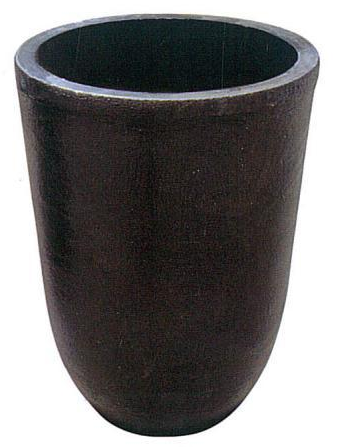
Use of clay-graphite crucibles
Clay-graphite crucibles are selected for batch melting of non-ferrous metals with charging and subsequent pouring. Graphite promotes heat transfer, and the binder forms the body. Service life depends on the material formulation, the protective coating and the operating mode.
The main areas of application — melting copper and copper alloys, aluminum and aluminum alloys, gold and silver. For brass, the zinc content and melting conditions matter; for bronze — the alloying elements. When working with precious metals, the purity of the crucible material is additionally checked.
When replacing a clay-graphite crucible with a silicon carbide one, compare the geometry, heating method, cycle frequency, temperature and fluxes. The material name alone is not enough for selection.
Some industrial grades of clay-graphite crucibles permit melting cast iron. For the versions presented, such a permission is not specified separately, so it cannot be extended to the whole range.
Dimensions table
How to read the dimensions
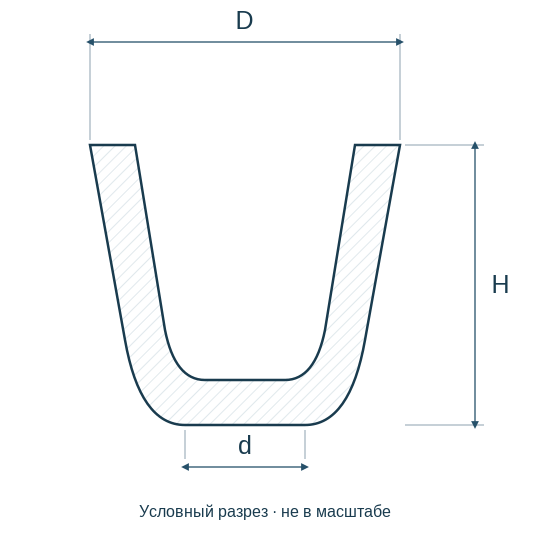
- D
- outer diameter at the top
- H
- overall height
- d
- outer diameter of the bottom
Dimensions in millimeters. The diagram shows the designations; the profile and tolerances are agreed according to the drawing.
Open a larger diagram| Size | D, mm | H, mm | d, mm |
|---|---|---|---|
| 1 | 70 | 80 | 46 |
| 2 | 87 | 107 | 60 |
| 3 | 105 | 120 | 71 |
| 5 | 118 | 145 | 83 |
| 8 | 127 | 168 | 94 |
| 10 | 137 | 180 | 100 |
| 12 | 150 | 195 | 107 |
| 16 | 160 | 205 | 111 |
| 20 | 178 | 225 | 120 |
| 25 | 196 | 250 | 128 |
| 30 | 215 | 260 | 146 |
| H30 | 208 | 425 | — |
| 40 | 230 | 285 | 165 |
| 50 | 257 | 314 | 179 |
| 60 | 270 | 327 | 186 |
| 70 | 280 | 360 | 190 |
| 80 | 296 | 356 | 189 |
| D80 | 260 | 320 | — |
| 100 | 321 | 379 | 213 |
| 120 | 345 | 388 | 229 |
| 150 | 362 | 440 | 251 |
| 200 | 400 | 510 | 284 |
| 250 | 430 | 557 | 285 |
| D250 | 320 | 620 | — |
| B300 | 455 | 560 | 290 |
| 300 | 455 | 600 | 290 |
| 350 | 455 | 625 | 330 |
| 400 | 526 | 661 | 318 |
| 500 | 531 | 713 | 318 |
| H500 | 540 | 750 | 380 |
| 600 | 580 | 610 | 380 |
| 750 | 600 | 650 | 380 |
| 800 | 610 | 700 | 400 |
| 1000 | 620 | 800 | 400 |
| 1500 | 780 | 890 | 460 |
On a phone, the table can be scrolled left and right.
The designations 1, 2, 100 and others are size numbers. They do not mean capacity for gold, copper or aluminum. For H30, D80 and D250, the bottom diameter is confirmed from the drawing; a dash in the table does not mean a zero dimension.
Material characteristics
| Indicator | Value |
|---|---|
| Refractoriness, °C, at least | 1630 |
| Carbon content, %, at least | 38 |
| Open porosity, %, at most | 35 |
| Bulk density, g/cm³, at least | 1,6 |
Refractoriness characterizes the behavior of the material in testing and is not a permitted temperature for long-term operation. The operating temperature is set for the specific melt, atmosphere and melting mode. The material properties of the selected version are confirmed when the order is agreed.
Difference from graphite crucibles for gold
Clay-graphite products and graphite crucibles of 1–8 kg for gold differ in material composition, manufacturing technology and dimensions. For replacement, check the geometry and conditions of use. The number of a clay-graphite crucible is not related to the rating for gold.
Ordering by size
State the version number together with the dimensions D × H × d, the metal or alloy grade, the operating temperature and the furnace type. To assess compatibility, the composition of the fluxes used and the crucible installation method are also needed.
Metals and heating method
For copper, aluminum, zinc, tin, lead, gold and silver, the version is selected for the specific melt. State the alloy grade, purity requirements and the fluxes used: this information is needed to check the compatibility of the clay-graphite material.
The version is agreed for an induction furnace, a resistance furnace or a fuel-fired furnace. Along with the dimensions, the heating method, atmosphere and duration of melting or holding are checked.