
Crucibles for melting aluminum and aluminum alloys
The clay-graphite crucibles of this series are designed for melting and holding aluminum and aluminum alloys. The table lists 19 versions with a nominal capacity from 150 to 560 kg for aluminum.
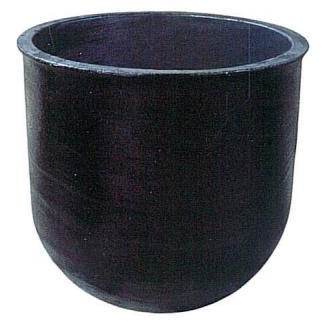
Melting of silumins and other aluminum alloys
Start the selection with the melt weight: for this series the capacity is given for aluminum. Then compare the crucible dimensions with the seating in the furnace. The size number alone does not determine the charge weight.
When selecting, distinguish between aluminum, Al–Si silumins, Al–Si–Cu alloys and alloys with magnesium. State the exact grade, the share of returns and scrap, the flux composition and the melt treatment method. Compatibility of the crucible with an alloy with a high magnesium content requires separate agreement.
Melting and long-term holding
When melting charge, uniform heating and resistance to repeated charging are important. For long-term holding — resistance to oxidation and to the action of the melt and fluxes. Crucibles of the same capacity may require different versions for a melting furnace and a dispensing furnace.
For zinc alloys, including Zn–Al systems, the rating for aluminum is not used as the permissible charge weight. The working volume, total weight and material of the selected version are checked.
Aluminum capacity and dimensions
How to read the dimensions
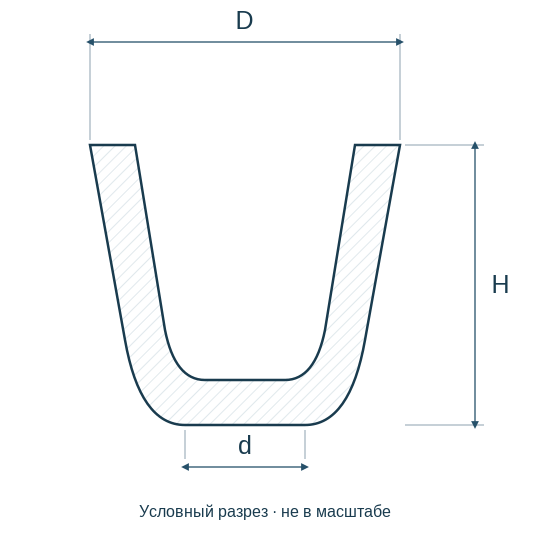
- D
- outer diameter at the top
- H
- overall height
- d
- outer diameter of the bottom
Dimensions in millimeters. The diagram shows the designations; the profile and tolerances are agreed according to the drawing.
Open a larger diagram| Size | D, mm | H, mm | d, mm | For aluminum, kg |
|---|---|---|---|---|
| 300 | 450 | 580 | 310 | 150 |
| 300 | 530 | 530 | 315 | 150 |
| 320 | 600 | 450 | 320 | 160 |
| 400 | 526 | 685 | 318 | 170 |
| 440 | 600 | 500 | 320 | 180 |
| 463 | 590 | 600 | 320 | 210 |
| 500 | 531 | 720 | 318 | 200 |
| 505 | 540 | 750 | 380 | 220 |
| 593 | 620 | 610 | 320 | 250 |
| 600 | 580 | 630 | 370 | 230 |
| 650 | 650 | 650 | 330 | 300 |
| 800 | 610 | 700 | 410 | 280 |
| 840 | 700 | 680 | 460 | 330 |
| 1000 | 620 | 800 | 420 | 320 |
| 970 | 720 | 750 | 460 | 400 |
| 1060 | 720 | 800 | 460 | 450 |
| 1100 | 720 | 890 | 460 | 480 |
| 1200 | 780 | 752 | 460 | 450 |
| 1500 | 780 | 890 | 460 | 560 |
On a phone, the table can be scrolled left and right.
Both 300 versions have a nominal capacity of 150 kg for aluminum, but their dimensions differ: D × H × d = 450 × 580 × 310 mm and 530 × 530 × 315 mm. The order must state the full set of dimensions.
Melting and holding of the melt
For melting, the heating mode and the charge composition matter; for holding — the duration of contact with the melt and the temperature. To choose the material, the aluminum alloy grade, the fluxes used and a description of the production cycle are needed.
Installation is considered for induction furnaces, resistance furnaces and fuel-fired furnaces of suitable design. For each heating method, the crucible version, the support, the clearances and the preparation procedure are agreed.
Dimensions for replacement
Check the outer diameter at the top D, the height H, the bottom diameter d and the bearing surface. The internal geometry and the permissible melt level are confirmed from the drawing: the nominal capacity does not replace verification of the working load.
For supply to match a sample, photos of the crucible and its markings are needed. If a new version is being selected, attach a drawing of the melting unit and state the weight of metal per cycle.
Use in casting production
When selecting for casting production, state whether the crucible will be used for melting or holding an aluminum or zinc alloy. The table gives capacity for aluminum only; the load of zinc alloy is determined separately. For the dispensing mechanism, also check the shape of the working opening, access to the melt and the crucible position.