
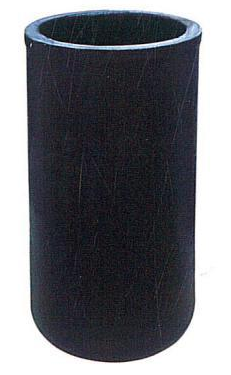
Silicon carbide crucibles for electric furnaces, DL series
The DL series includes 19 versions for medium-frequency induction furnaces and resistance furnaces. The crucible is selected by the geometry of the melting unit, the metal and the heating mode. The number in the model designation is the version number and does not specify the charge weight.
Which metals the DL series is selected for
The DL series is considered for melting non-ferrous metals: copper and copper alloys, aluminum and aluminum alloys. For brass, tin or aluminum bronze, silumin and Al–Mg alloy, state the exact grade and the fluxes used.
When replacing a DL crucible, check the designation and all the body dimensions. For a new melting unit, first determine the metal, heating method and working load, then select the version. The DL designation does not set a common temperature mode for all furnaces.
Induction furnace and resistance furnace
In a resistance furnace, energy passes from the heating elements to the crucible and the melt. In an induction system, the heating distribution also depends on the electrophysical properties of the crucible and the metal and on the operating frequency. Therefore, replacement between these systems is agreed in advance, even if the body fits into the chamber.
For melting steel and special alloys, the suitability of the DL series material is confirmed separately. The type of electric heating alone does not determine which metals can be melted in the crucible.
DL series crucible dimensions
How to read the dimensions
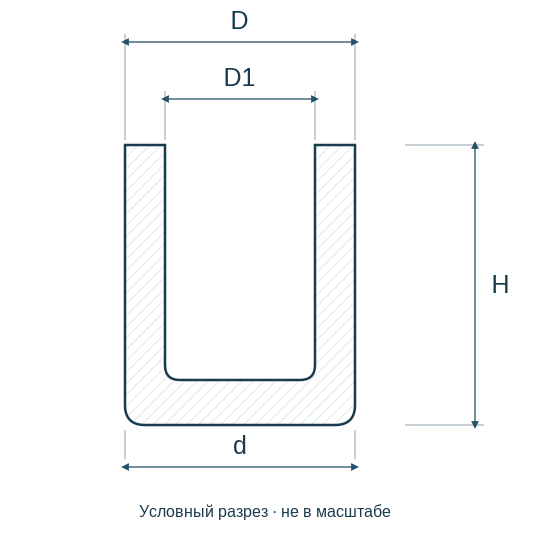
- D
- outer diameter at the top
- D1
- inner diameter at the top
- H
- overall height
- d
- outer diameter of the bottom
Dimensions in millimeters. The diagram shows the designations; the profile and tolerances are agreed according to the drawing.
Open a larger diagram| Size | D, mm | D1, mm | H, mm | d, mm |
|---|---|---|---|---|
| DL100 | 245 | 180 | 350 | 180 |
| DL165 | 300 | 220 | 600 | 290 |
| DL170 | 320 | 245 | 500 | 310 |
| DL210 | 320 | 250 | 600 | 310 |
| DL350 | 415 | 349 | 570 | 380 |
| DL400 | 270 | 210 | 1560 | 265 |
| DL430 | 418 | 349 | 670 | 380 |
| DL500-1 | 430 | 350 | 770 | 380 |
| DL500-2 | 480 | 420 | 653 | 275 |
| DL785 | 620 | 530 | 600 | 610 |
| DL905 | 620 | 530 | 650 | 610 |
| DL1000 | 510 | 440 | 910 | 400 |
| DL1250 | 620 | 535 | 850 | 610 |
| DL1350 | 594 | 500 | 910 | 580 |
| DL1450 | 710 | 630 | 720 | 705 |
| DL1500 | 650 | 550 | 1000 | 630 |
| DL1600 | 720 | 635 | 800 | 705 |
| DL5000 | 900 | 780 | 1300 | 875 |
| DL5300 | 900 | 780 | 1600 | 875 |
On a phone, the table can be scrolled left and right.
D — outer diameter at the top, D1 — inner diameter at the top, H — overall height, d — outer diameter of the bottom. Dimensions are in millimeters. The working depth, wall profile and tolerances are agreed per the drawing.
How to select a crucible for an electric furnace
In a resistance furnace, check the distance to the heating elements, the installation method and the bottom support. In an induction furnace, also take into account the converter frequency and the inductor dimensions: the heating distribution between the crucible and the metal depends on them.
When replacing, compare not only the top diameter but also the lower part of the body. For example, DL500-1 and DL500-2 differ in all four dimensions. These versions cannot be considered interchangeable by the DL500 designation alone.
What to provide for selection
- Furnace type and model; for an induction unit — the operating frequency.
- Metal or alloy grade, the weight of one melt and the operating temperature.
- Drawing or dimensions of the installed crucible, the support shape and the mounting clearances.
- Fluxes used, the number of crucibles and the operating mode: melting or holding the melt.
The version, material and first-heating procedure are agreed for the selected furnace. The dimension diagram is intended for reading the table and does not replace the installation drawing.