
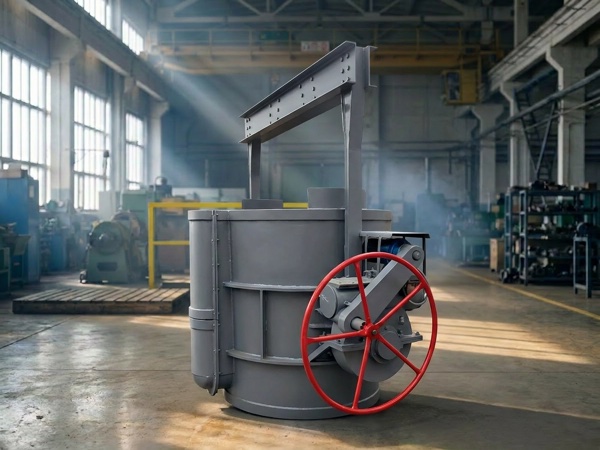
УИК-С-0.3
- Capacity, t
- 0.3
- Diameter, mm
- 512
- Height, mm
- 540
- Gear ratio
- 46
- Overall dimensions L×W×H, mm
- 1220×720×1385
Tilting steel-pouring ladles receive metal from the furnace, move it to the pouring point and deliver it into the mold through the pouring spout. The body is tilted by a rotary mechanism. The series — 12 sizes from 0,3 to 10 t; we select the version to suit your steel, pouring batch and crane.
An engineer will select a model for your metal and send a cost estimate.
We make ladles to order. We confirm the availability of the selected size as of the date of the request.
Warranty on the gearbox of the tilting mechanism. Lining and consumable units are not included.
Shipment from the warehouse. Delivery by road and by rail.
Send us the alloy, the metal weight and the pouring method — we will prepare a proposal with the price and lead time.
Fill in the questionnaire →12 models in the series. Pick up on the capacity and dimensions. Service and ZIP - under your object.


Capacity in the tables is the mass of metal, dimensions are in millimeters. The designations refer to the diagram of this series: Φ1 — inner diameter at the top, Φ2 — diameter at the bottom, H — body height, A and B — overall dimensions of the assembled ladle.
The diagram shows the principle of dimensioning and does not replace the working drawing. The working fill and the final dimensions depend on the lining thickness and the freeboard — when agreeing on the order, request the drawing of the selected version.
This ladle links the melting and molding sections: liquid steel is received into it, carried to the molds and poured. It is chosen for layouts in which the metal is delivered through the upper pouring portion by tilting the body. The capacity is matched to the mass of a single pouring batch, and not only to the furnace volume.
For example, when several molds are poured from one ladle, the metal for the castings and gating systems, the process remainder and the duration of the whole pouring operation must be taken into account. For one large mold, it is checked whether the working mass of the ladle matches the required pouring mass. The specific load is determined by the plant's process engineer.
The welded steel body serves as the load-bearing shell. A refractory lining is applied inside it, separating the melt from the metal structure. The suspension crossbeam transfers the load to the crane hook, and the trunnions form the axis of rotation of the body.
The handwheel changes the tilt angle through the gearbox. The melt flows to the spout and exits through the upper pouring portion. The gear ratio is given in the table for each size: it cannot be selected separately from the mass of the ladle, the position of the center of gravity and the required tilting mode.
This layout has no long narrow pouring channel or bottom nozzle through which all the metal must pass. This simplifies access to the inner surface and the pouring section. However, top pouring requires control of surface slag: it may get into the stream together with the metal.
A tilting ladle is suitable when the section provides space for tilting, the drive is accessible to the operator, and the spout position can be aligned with the pouring basin of the mold. When selecting, the pouring height and the trajectory of the spout are important: they change during tilting.
If the metal needs to be discharged vertically downward without tilting the body, a stopper ladle is considered. If the task is to arrange pouring with metal drawn from below the surface slag layer — tilting and teapot designs are compared. The name «steel-pouring» itself describes the purpose by metal, but does not yet determine the method of discharge.
The material and thickness of the lining are selected according to the steel grade, working temperature, slag composition and duty cycle. Changing the refractory thickness changes the internal volume, the assembled mass and the pouring conditions. Therefore the same external geometry does not guarantee the same working capacity with different linings.
We supply the ladle without lining. The customer applies it at their own plant; by agreement, we offer lining work on site. Drying and preliminary heating are carried out according to the requirements for the selected refractories. To select a stand, the dimensions of the inner cavity and mouth are needed, not only the ladle tonnage.
We supply ladles without lining, with a technical passport. For a first inquiry, the data you already have is enough: a description of the task, photos or documents. We prepare a proposal for a standard ladle within one day if the initial data is sufficient.
Supply to order — from 30 days. For a non-standard design, we agree on the drawing, dimensions and suspension. Before shipment we check completeness, dimensions and the operation of the tilting mechanism; on request we provide a photo or video.
The gearbox warranty is 6 months; the other units are not covered. Warranty terms and spare parts.
If you did not find an answer — call us, and an engineer will review your task.
Only after checking the pouring layout. In a tilting ladle, the metal exits through the upper spout when the body is tilted; in a stopper ladle — through the bottom assembly. The stream position, the height requirements and the working space differ.
It is a characteristic of the mechanical transmission of the tilting drive, not the pouring speed. The actual metal flow also depends on the tilt, the fill level and the shape of the pouring section.
No. The lining, the total mass on the hook, the overall dimensions, the suspension, the mold height and the tilting zone are also checked. The working fill is recorded in the order documentation.
We select the capacity, type of drain and lining composition for a specific alloy, seriality and casting technology.
An engineer will contact you, clarify the task and suggest a solution for your production process.
A manufacturer with a complete engineering cycle: equipment selection, commissioning and service within one company.
We manufacture induction melting furnaces and heaters, shot blasting equipment, cooling systems and steel casting ladles, taking responsibility as the manufacturer.
Selection, design, delivery, installation, commissioning, training and service within one company.
We address most metallurgical and foundry production requirements, from an individual furnace to a turnkey production area.
Operating since 2014. Completed projects of varying complexity and engineers with practical commissioning experience.
Some equipment is available from stock, reducing lead times for urgent requirements.
6-month warranty on our own production. Post-warranty maintenance, spare parts and service — on an ongoing basis.
Send us another company's proposal — we will compare the equipment list, configuration and cost.