
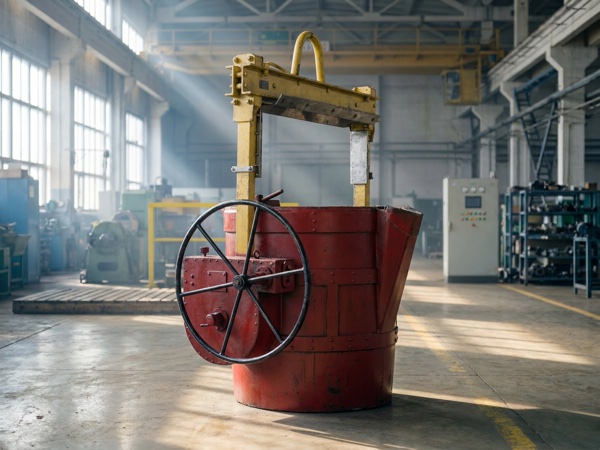
УИК-Ч-0.3
- Capacity, t
- 0.3
- Diameter, mm
- 512
- Height, mm
- 540
- Gear ratio
- 46
- Overall dimensions L×W×H, mm
- 1220×720×1385
Cast iron foundry ladles of the TB series are used to receive cast iron, move it between sections and pour it by tilting the body. This is a transport-and-pouring series: 15 sizes from 0,3 to 15 t. A separate design is provided for treating cast iron with a modifier.
An engineer will select a model for your metal and send a cost estimate.
We make ladles to order. We confirm the availability of the selected size as of the date of the request.
Warranty on the gearbox of the tilting mechanism. Lining and consumable units are not included.
Shipment from the warehouse. Delivery by road and by rail.
Send us the alloy, the metal weight and the pouring method — we will prepare a proposal with the price and lead time.
Fill in the questionnaire →13 models in the series. Pick up on the capacity and dimensions. Service and ZIP - under your object.


Capacity in the tables is the mass of metal, dimensions are in millimeters. The designations refer to the diagram of this series: Φ1 — inner diameter at the top, Φ2 — diameter at the bottom, H — body height, A and B — overall dimensions of the assembled ladle.
The diagram shows the principle of dimensioning and does not replace the working drawing. The working fill and the final dimensions depend on the lining thickness and the freeboard — when agreeing on the order, request the drawing of the selected version.
The ladle receives cast iron after melting and delivers it to the site of the next operation. Depending on the shop layout, this may be pouring molds or transferring into other equipment. When making this selection, it is important to define the role of the ladle: it carries the entire heat, serves a group of molds or passes the metal on for treatment.
The range from 0,3 to 15 t makes it possible to match the ladle to the furnace tap and the organization of pouring. But capacity by itself does not determine the productivity of the section. The duration of filling, moving, pouring and preparing for the next cycle must be taken into account.
The body holds the lined working cavity; the suspension connects the ladle to the lifting equipment. During pouring, the body rotates on the trunnions, directing the metal through the pouring section. This layout allows cast iron to be received and poured with a single ladle, if the process provides for it.
For the process engineer, the position of the spout relative to the mold and the ability to control pouring throughout the whole batch are important. For the operations department — access to the drive, supports and refractory lining. These requirements should be compared with the section layout before the order is placed.
Open access to the working cavity makes it easier to inspect the condition of the lining. Since the metal exits through the upper pouring portion, surface slag must be taken into account during pouring. The ladle does not replace the melt cleaning operations provided for by the process.
The main task of the TB series — transporting and pouring. A ladle for modification has a different primary task: to provide conditions for treating the melt with additives. For it, the bath depth, the reaction zone, the headroom above the metal and the method of introducing the modifier are worked out separately.
If the enterprise produces high-strength cast iron with spheroidal graphite, an ordinary pouring ladle cannot automatically be considered ready for the sandwich process. First, the treatment process and the design of the reaction cavity are agreed. After treatment, the further path of the metal — directly into the molds or via a pouring ladle — is determined by the production layout.
Specify the type of cast iron, the working temperature and the actual batch mass. Cast irons of different grades and modes may require different refractories. Capacity in tonnes should not be converted into geometric volume without taking into account the density of the metal, the lining and the freeboard.
When checking the crane, the mass of the body, lining, melt and installed equipment is taken into account. The overall dimensions are used to check the filling location, aisles, hook height and the ladle position when pouring. The dimensions of the TB series should not be carried over to ladles of a different design with the same tonnage.
Supply — without lining, with a passport. The lining is more often done by the customer; this service can be agreed separately. Before operation begins, the refractories must be prepared according to the procedure adopted at the plant. A compatible stand is selected for drying and heating.
We supply ladles without lining, with a technical passport. For a first inquiry, the data you already have is enough: a description of the task, photos or documents. We prepare a proposal for a standard ladle within one day if the initial data is sufficient.
Supply to order — from 30 days. For a non-standard design, we agree on the drawing, dimensions and suspension. Before shipment we check completeness, dimensions and the operation of the tilting mechanism; on request we provide a photo or video.
The gearbox warranty is 6 months; the other units are not covered. Warranty terms and spare parts.
If you did not find an answer — call us, and an engineer will review your task.
In descriptions, these names may refer to similar tasks, but the operation must be clarified for an order. Transporting cast iron, pouring molds and treating with a modifier place different demands on the design.
The standard transport-and-pouring model should not be chosen for this task without verification. For cast iron treatment, we offer a separate series with agreement on the reaction zone and the working fill.
Yes, a request for a separate version can be submitted. For example, 6 t is absent from the published TB range; this is not a reason to substitute the characteristics of a neighboring model. We will agree the design based on the source data.
We select the capacity, type of drain and lining composition for a specific alloy, seriality and casting technology.
We select a ladle for your melting furnace, manufacture, deliver, train operators and stay on the service. Replacing lining is our strength.
One contract, one point of responsibility. From the first calculation to the replacement of lining on the site - all stages are carried out by our engineers for your facility.
Request a turnkey calculation →An engineer will contact you, clarify the task and suggest a solution for your production process.
A manufacturer with a complete engineering cycle: equipment selection, commissioning and service within one company.
We manufacture induction melting furnaces and heaters, shot blasting equipment, cooling systems and steel casting ladles, taking responsibility as the manufacturer.
Selection, design, delivery, installation, commissioning, training and service within one company.
We address most metallurgical and foundry production requirements, from an individual furnace to a turnkey production area.
Operating since 2014. Completed projects of varying complexity and engineers with practical commissioning experience.
Some equipment is available from stock, reducing lead times for urgent requirements.
6-month warranty on our own production. Post-warranty maintenance, spare parts and service — on an ongoing basis.
Send us another company's proposal — we will compare the equipment list, configuration and cost.